20-Port, Panel Sector Antenna ( 698 - 2690 MHz )

₹0.00

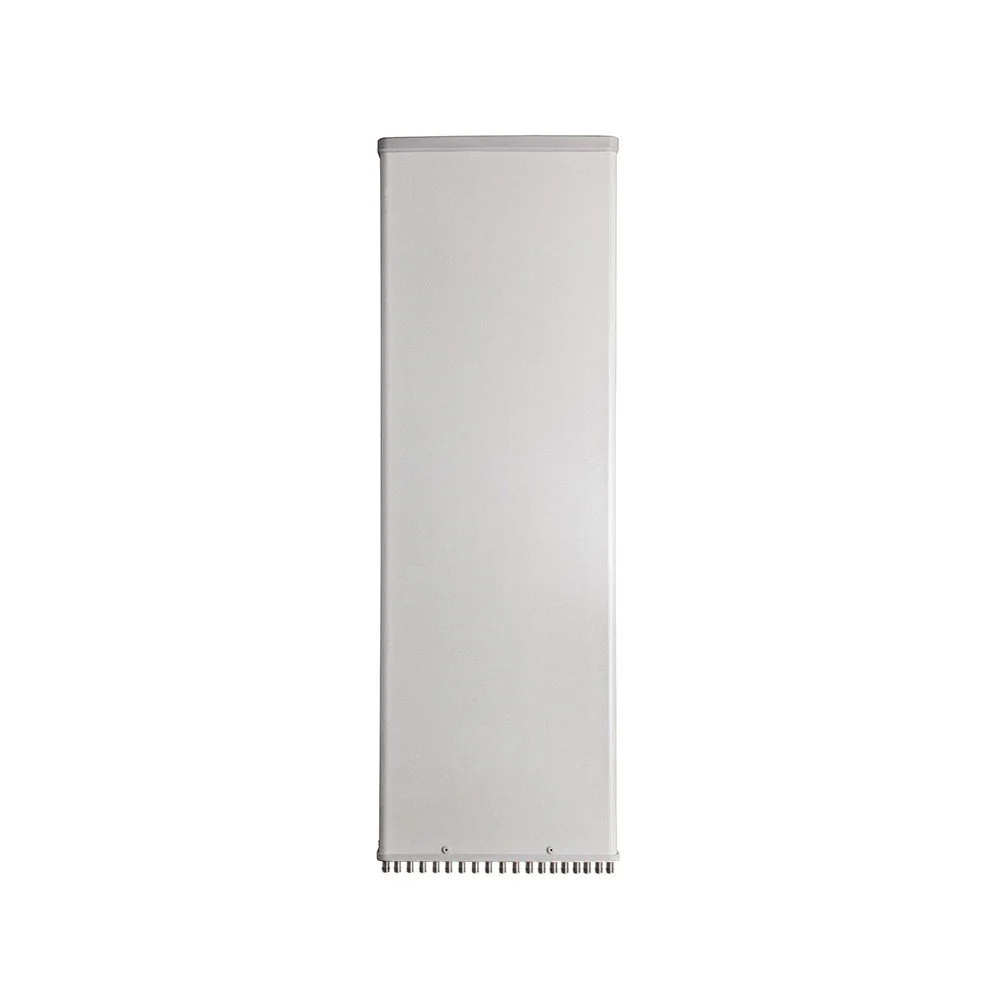
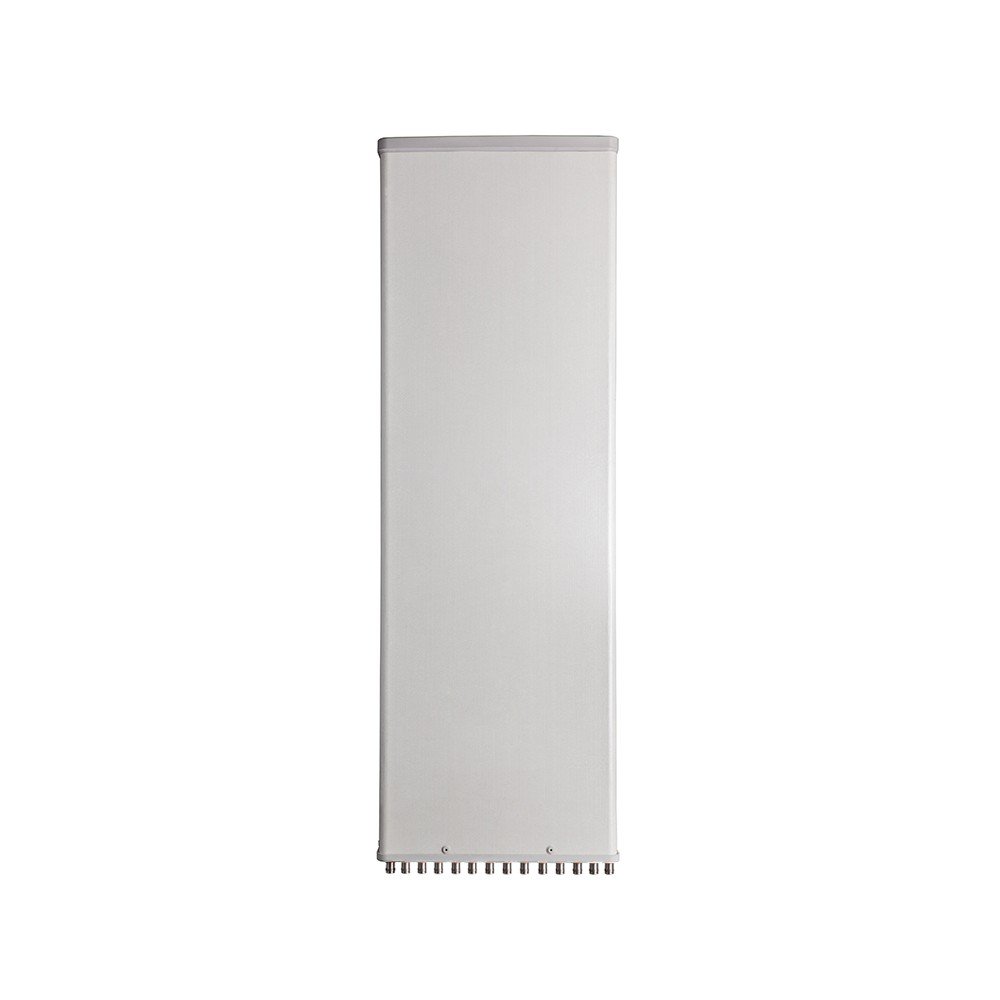
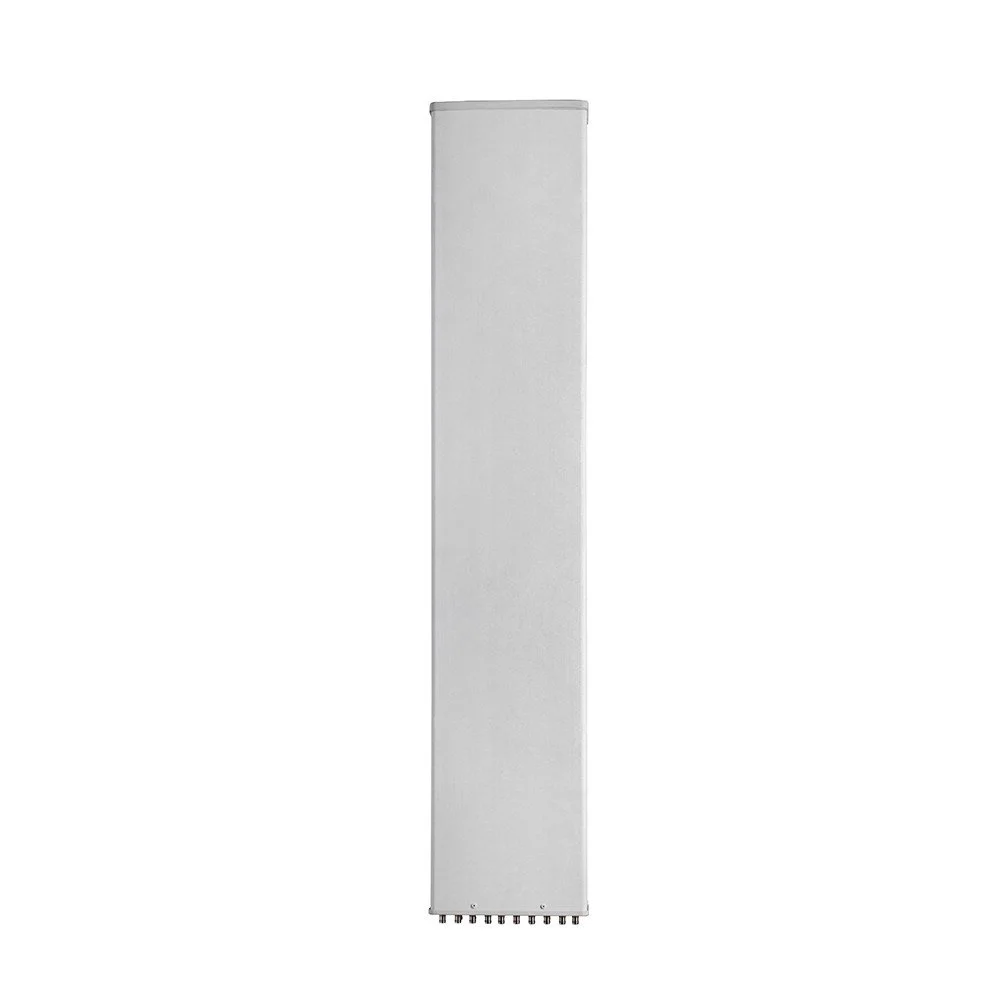
20‑Port Panel Sector Antenna (698–2690 MHz)

Overview

  • Frequency range: 698–2690 MHz — covers LTE bands, 3G, and legacy cellular allocations; suitable for multi‑operator macro sites and shared infrastructure.

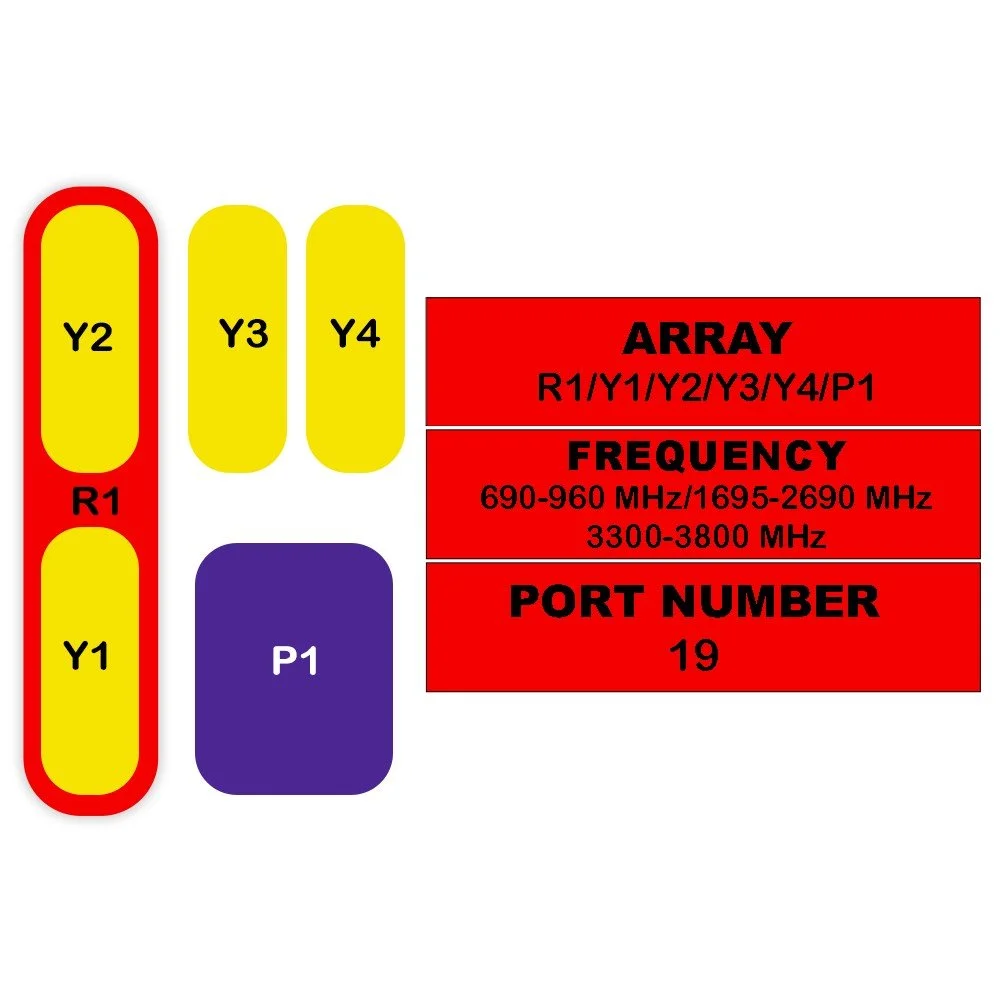
  • Ports: 20 ports enabling multi‑input multi‑output (MIMO), diversity, and carrier aggregation across multiple bands.

  • Form factor: Slim, sector panel designed for rooftop, tower, and wall‑mount installations with low visual profile and robust environmental protection.

Key Features :

  • Wideband performance: Single‑antenna solution across 698–2690 MHz reduces the need for multiple discrete antennas and simplifies inventory and site integration.

  • Multi‑port architecture: 20 individually terminated ports support simultaneous multi‑sector configurations, multi‑operator deployments, or high‑order MIMO (e.g., 8x8 and beyond depending on configuration) and multiple carriers.

  • Optimized radiation patterns: Sectorized azimuth beamwidth (typically 65°–90° configurable per model) with controlled elevation tilt for efficient cell coverage and reduced inter‑cell interference.

  • Low VSWR and high port isolation: Ensures efficient power transfer, minimizes mutual coupling between ports, and preserves MIMO channel capacity.

  • High gain across bands: Carefully tuned element arrays deliver consistent gain to maximize link budget for both uplink and downlink.

  • Robust construction: IP65/IP67 environmental rating, corrosion‑resistant radome and mounting hardware for long service life in harsh outdoor conditions.

  • Lightning and surge protection: Integrated or easy‑to‑fit surge protection options to protect RF chains and meet telco site safety requirements.

  • Easy installation and alignment: Lightweight design, universal mounting bracket with azimuth/elevation adjustment, and clearly labeled feeders for fast site commissioning.

  • Weathering and UV resistance: Materials and finishes formulated for extended exposure to sun, salt spray, and temperature cycling.

Typical Specifications (example) :

  • Frequency range: 698–2690 MHz

  • Number of ports: 20

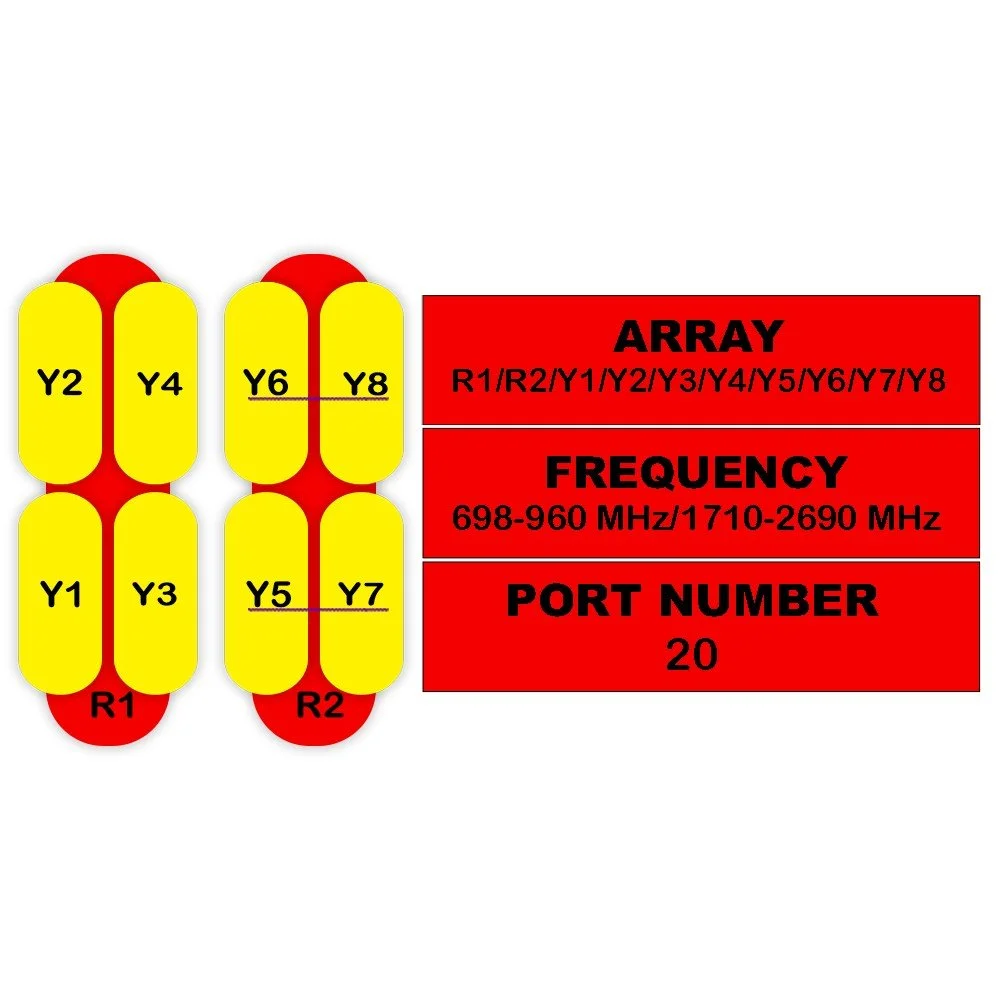
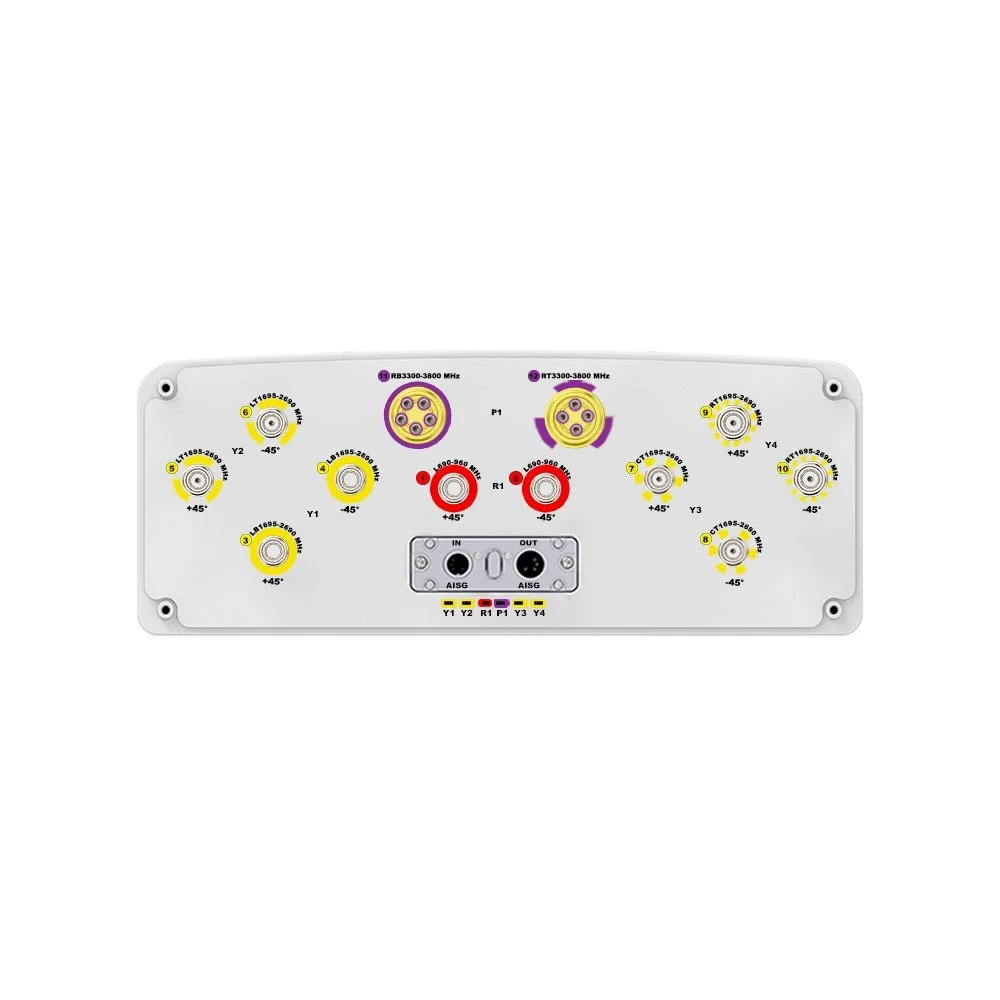
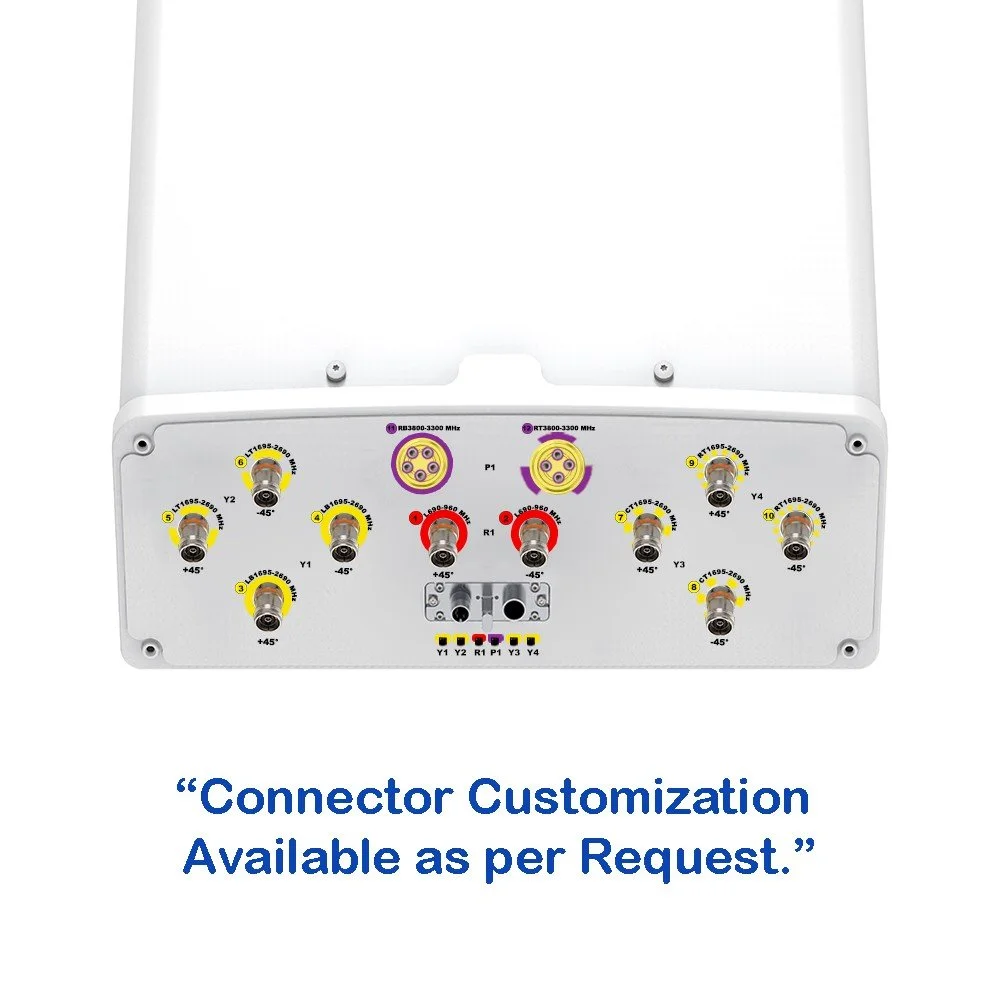
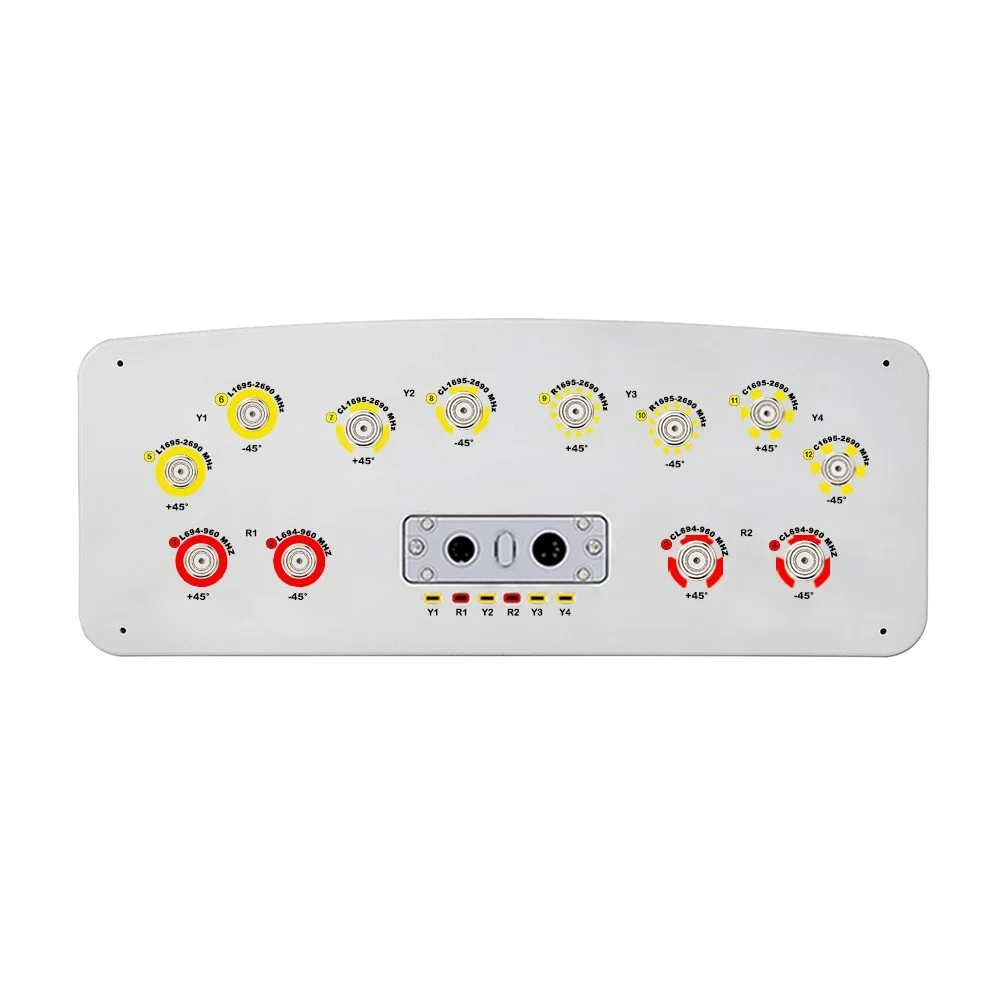
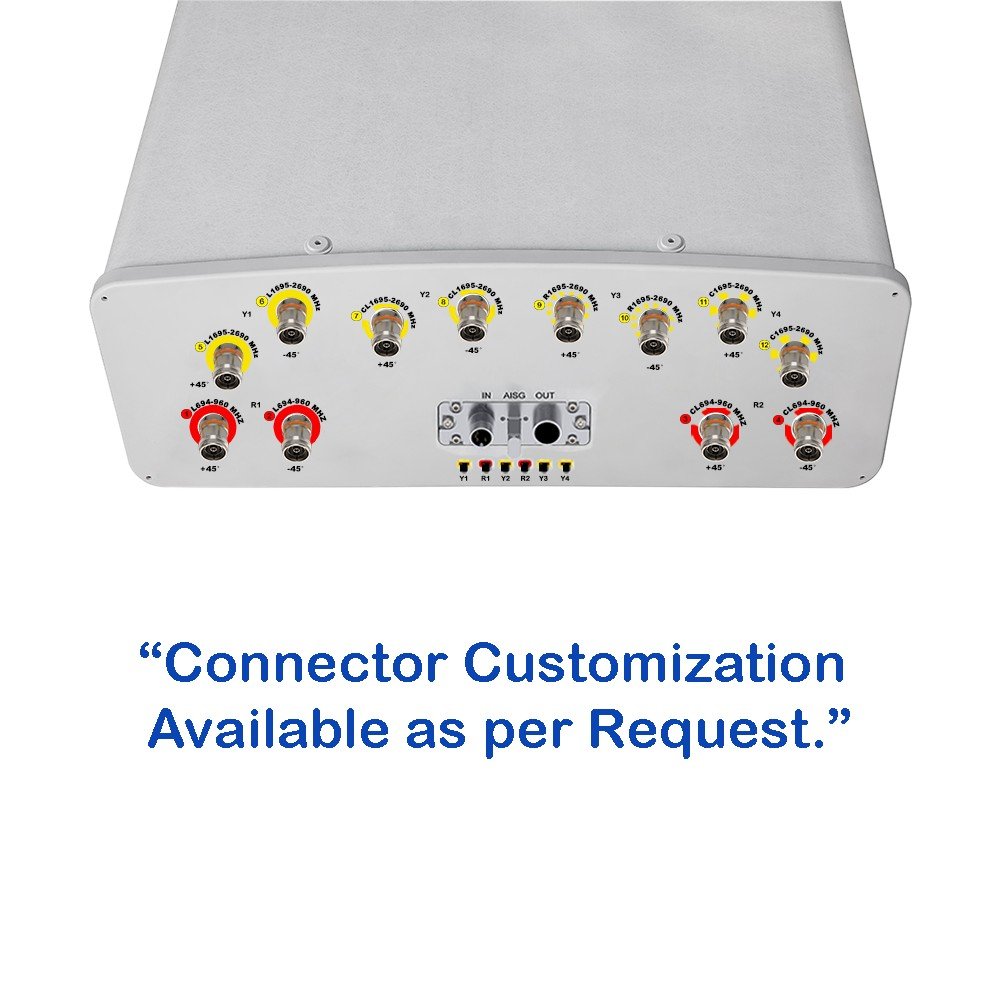
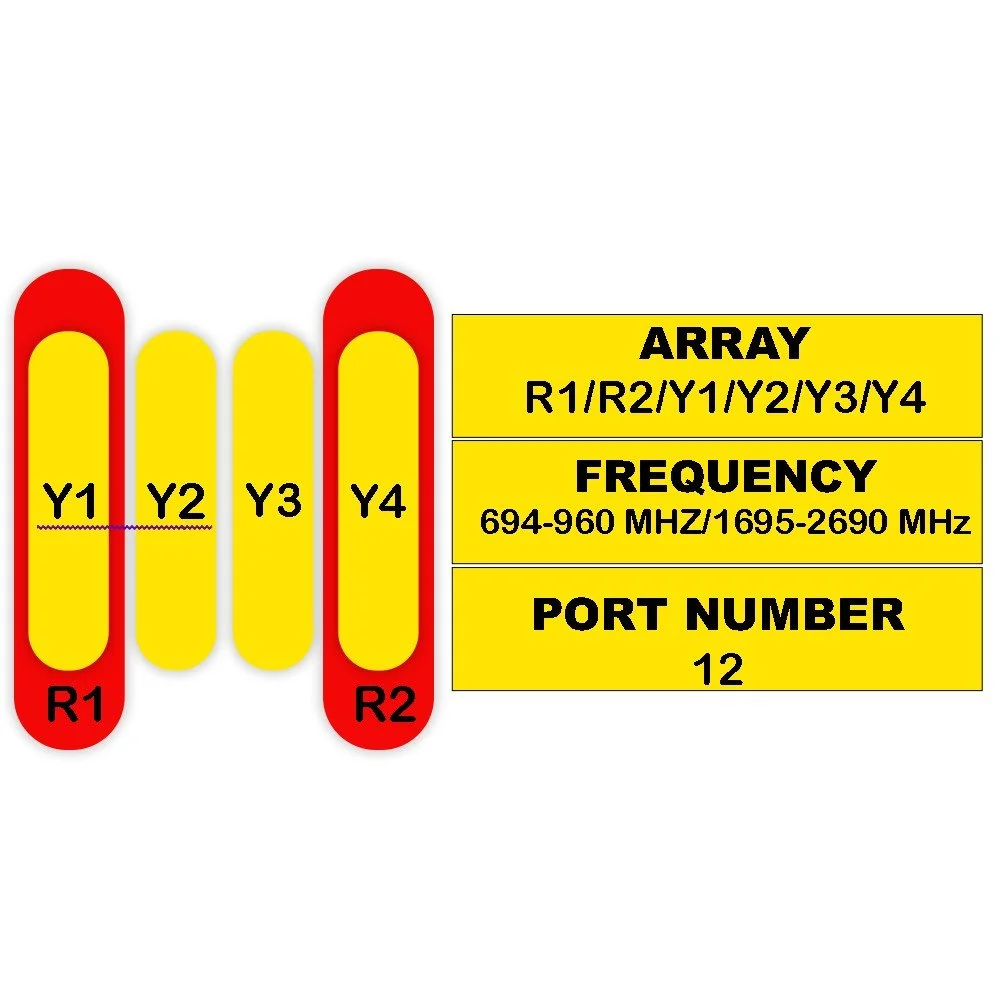
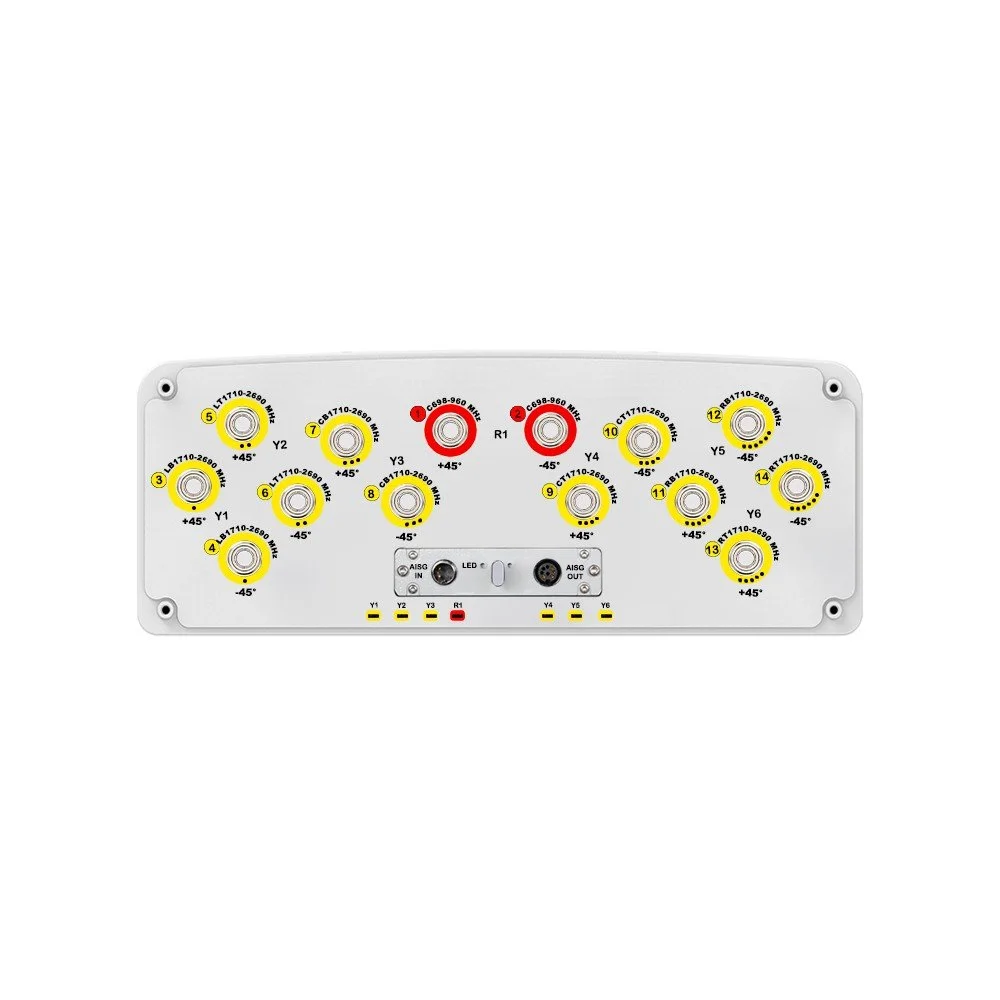
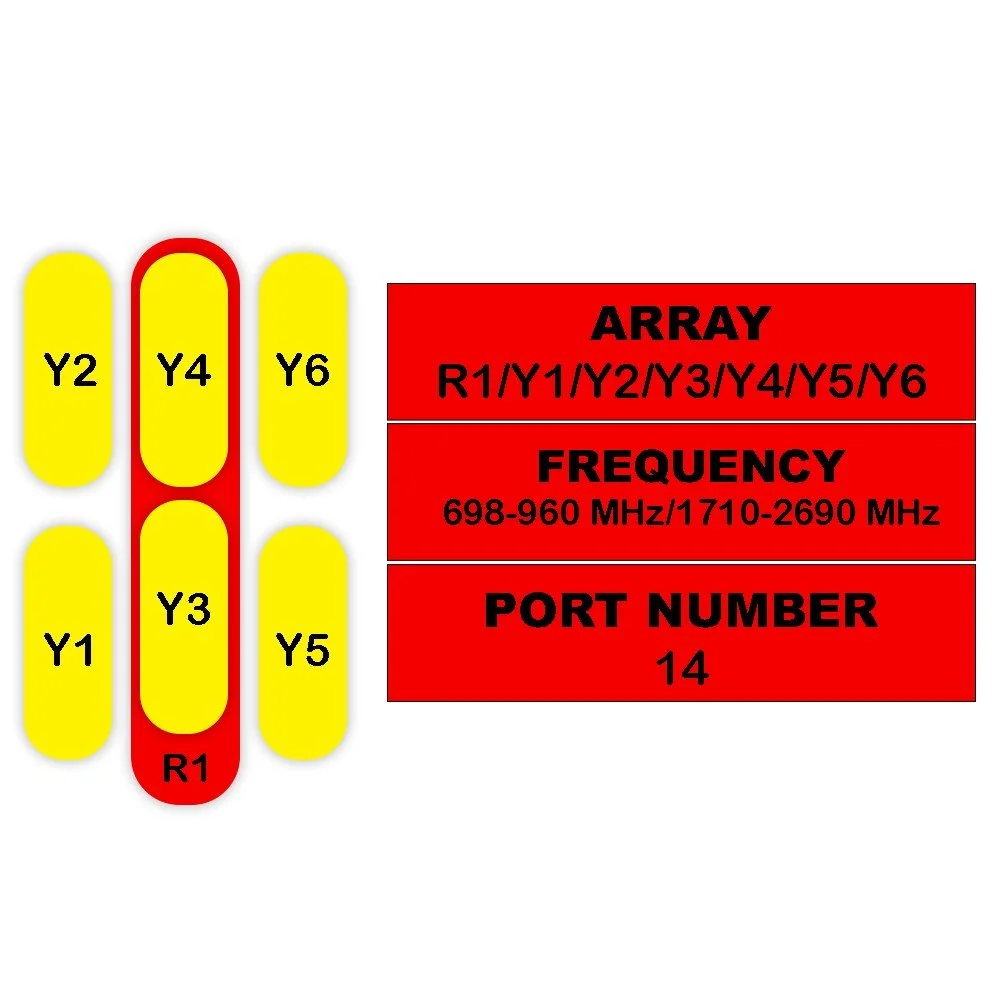
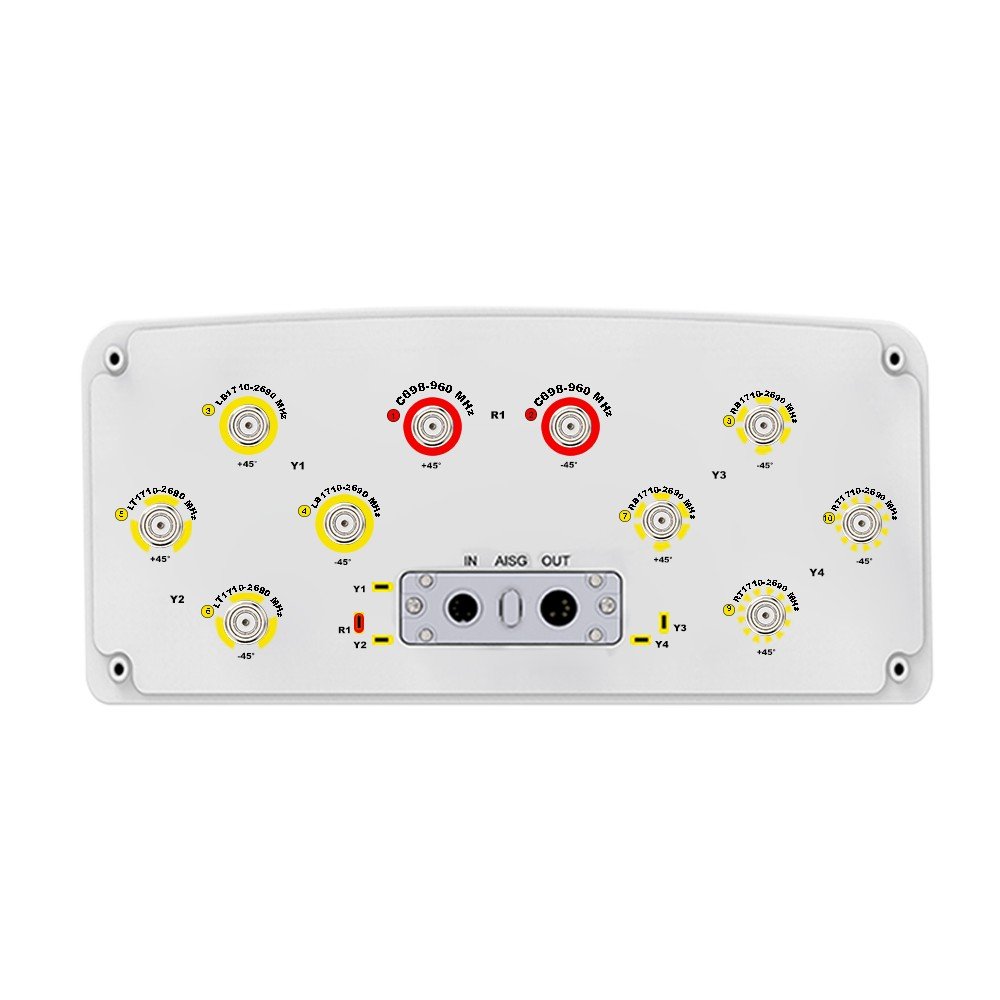
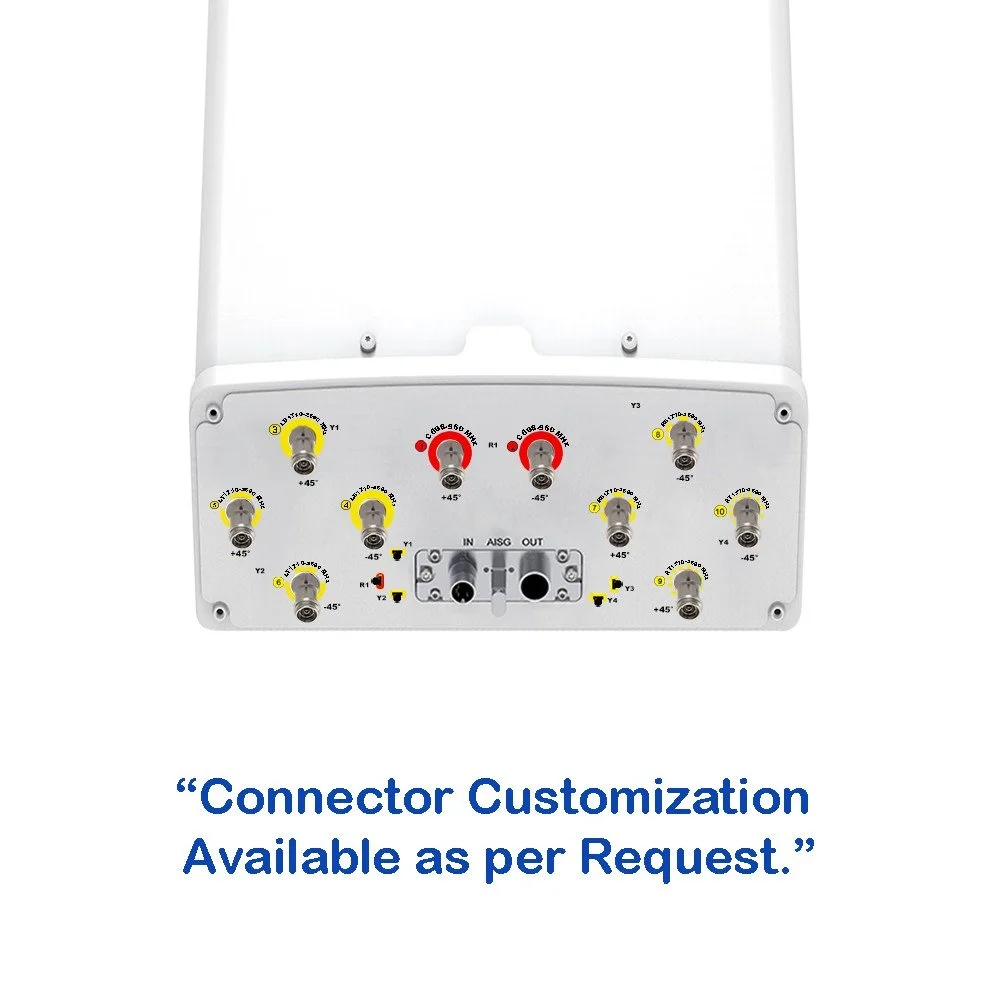
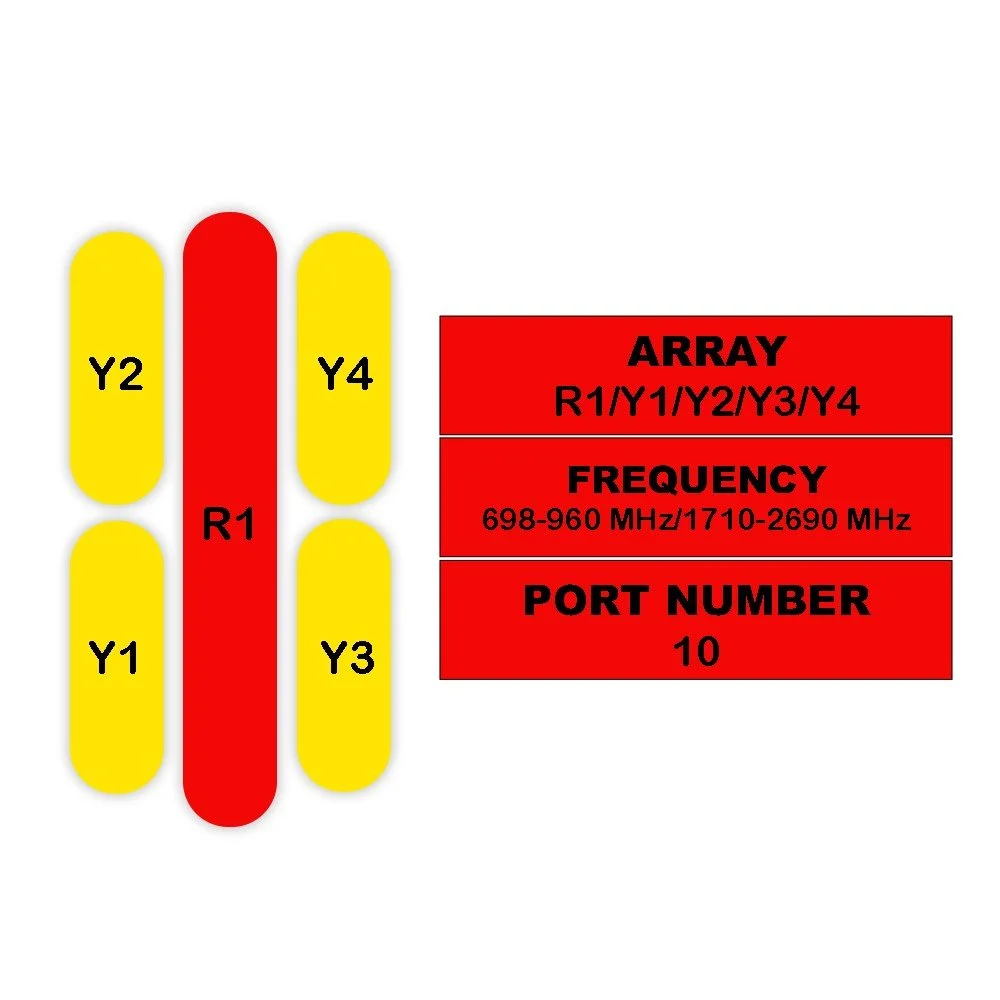
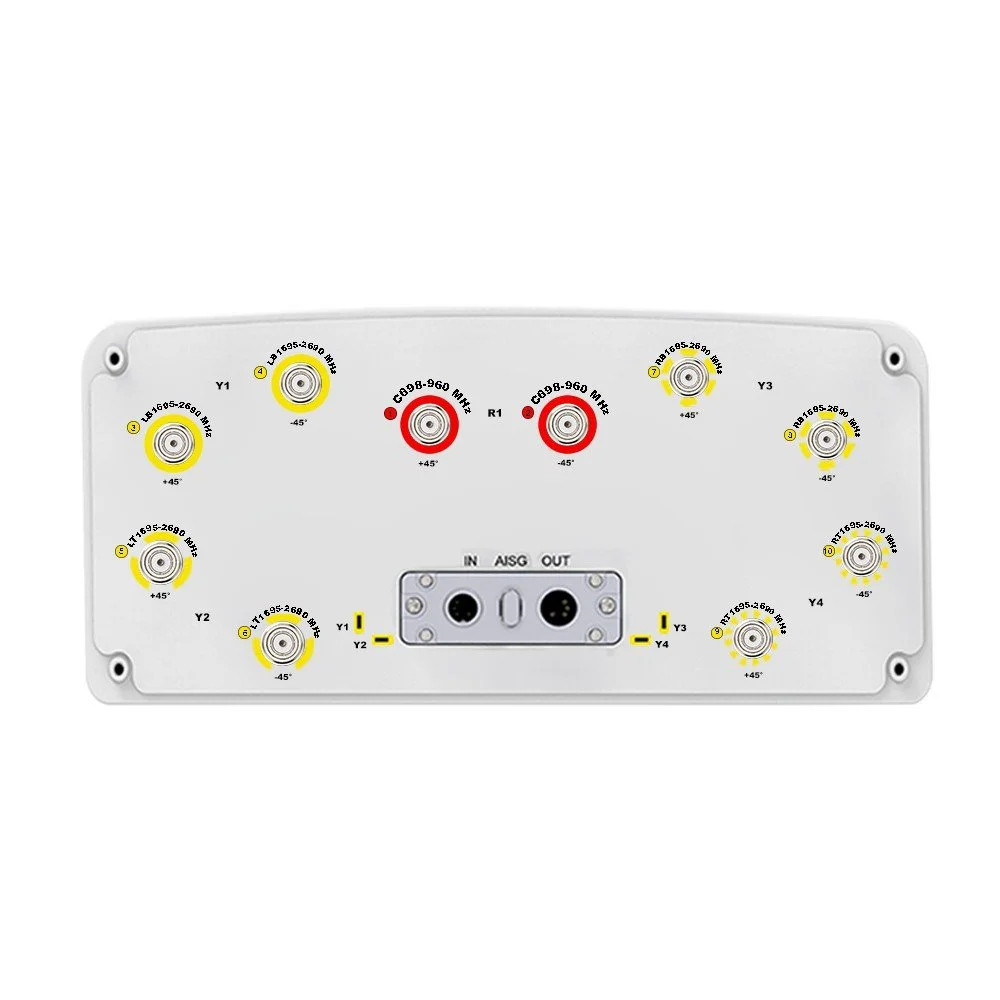
  • Port configuration: Combination of low‑band and mid‑band port groups (customizable mapping)

  • Polarization: Dual linear (vertical/horizontal) or slant ±45° per subarray

  • Nominal gain: 698–960 MHz: ~6–9 dBi; 1710–2690 MHz: ~8–12 dBi (model dependent)

  • VSWR: < 2.0:1 typical across each band

  • Port isolation: > 20 dB typical between co‑polarized adjacent ports; > 30 dB cross‑polarization isolation

  • Front-to-back ratio: > 20 dB typical

  • Beamwidth (azimuth): 65° / 90° variants available

  • Beamwidth (elevation): narrow beam shaping for sector coverage (model dependent)

  • Power handling: Meets standard BTS antenna input power requirements (check model for per‑port limits)

  • Impedance: 50 ohm

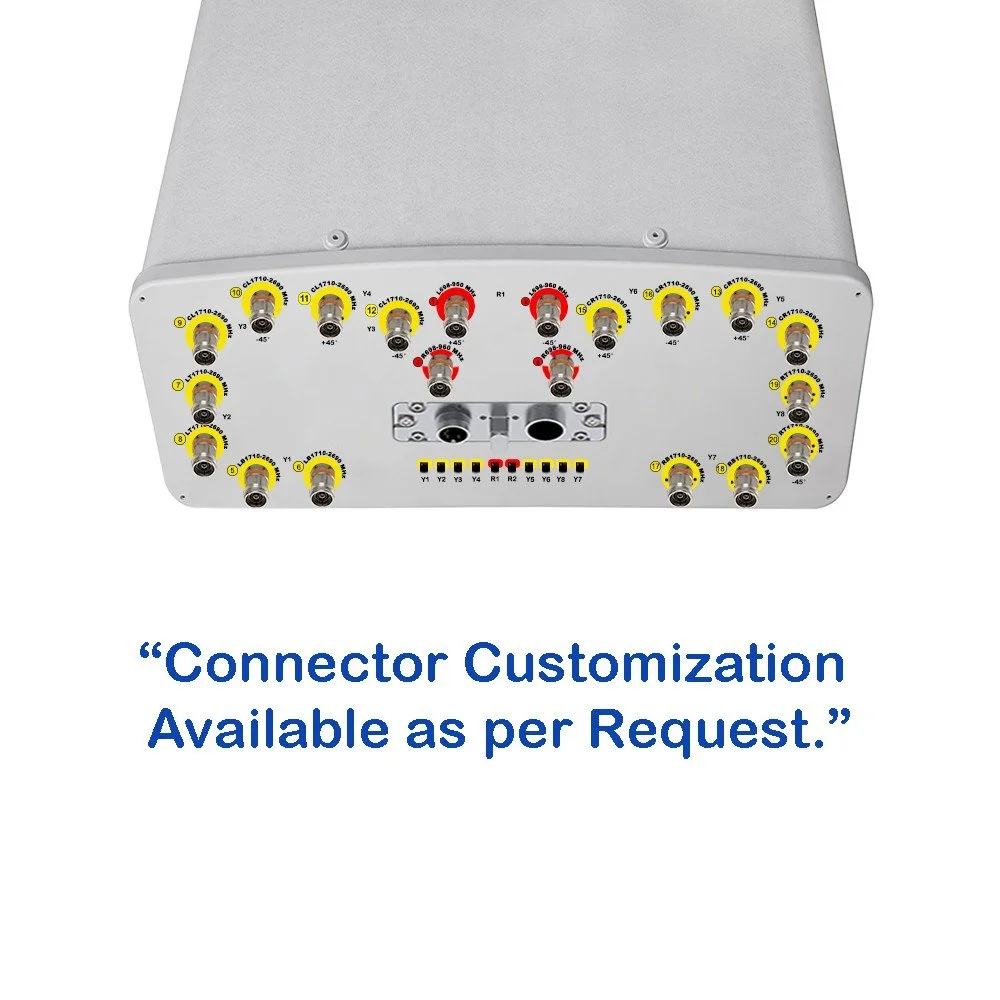
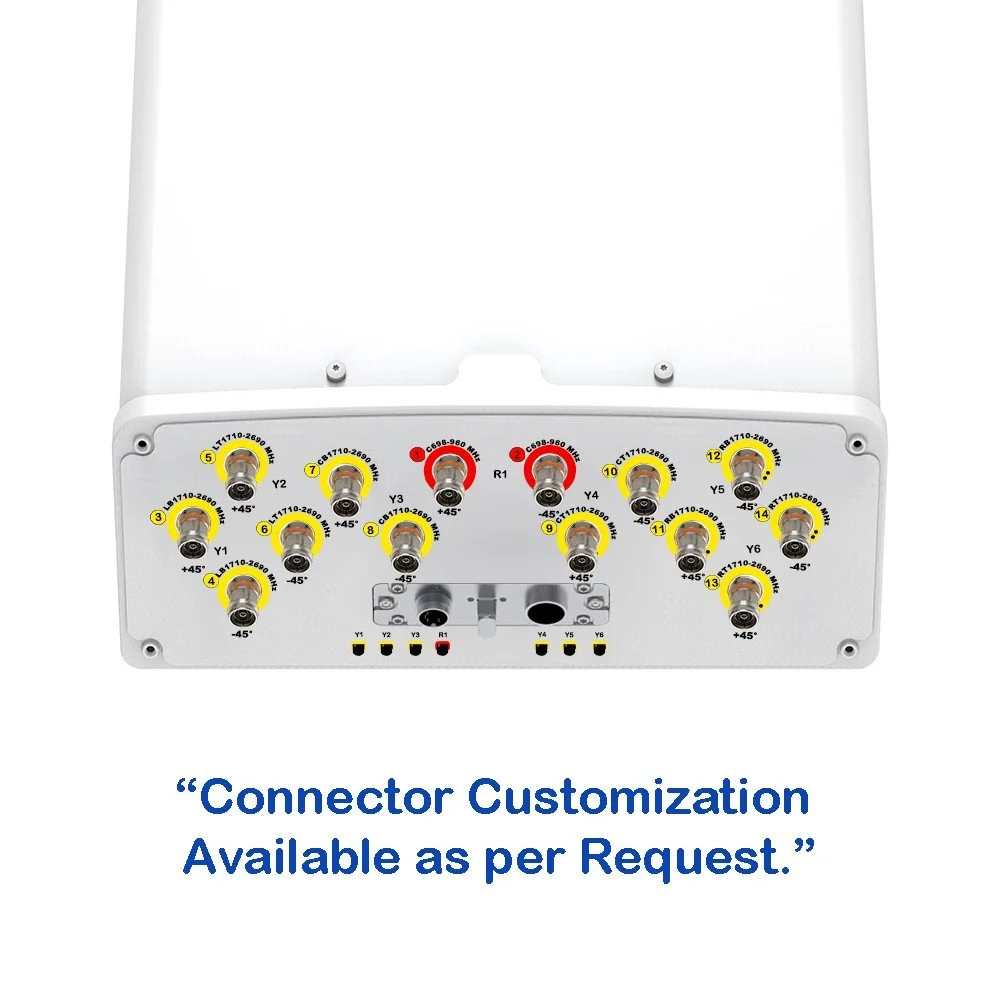
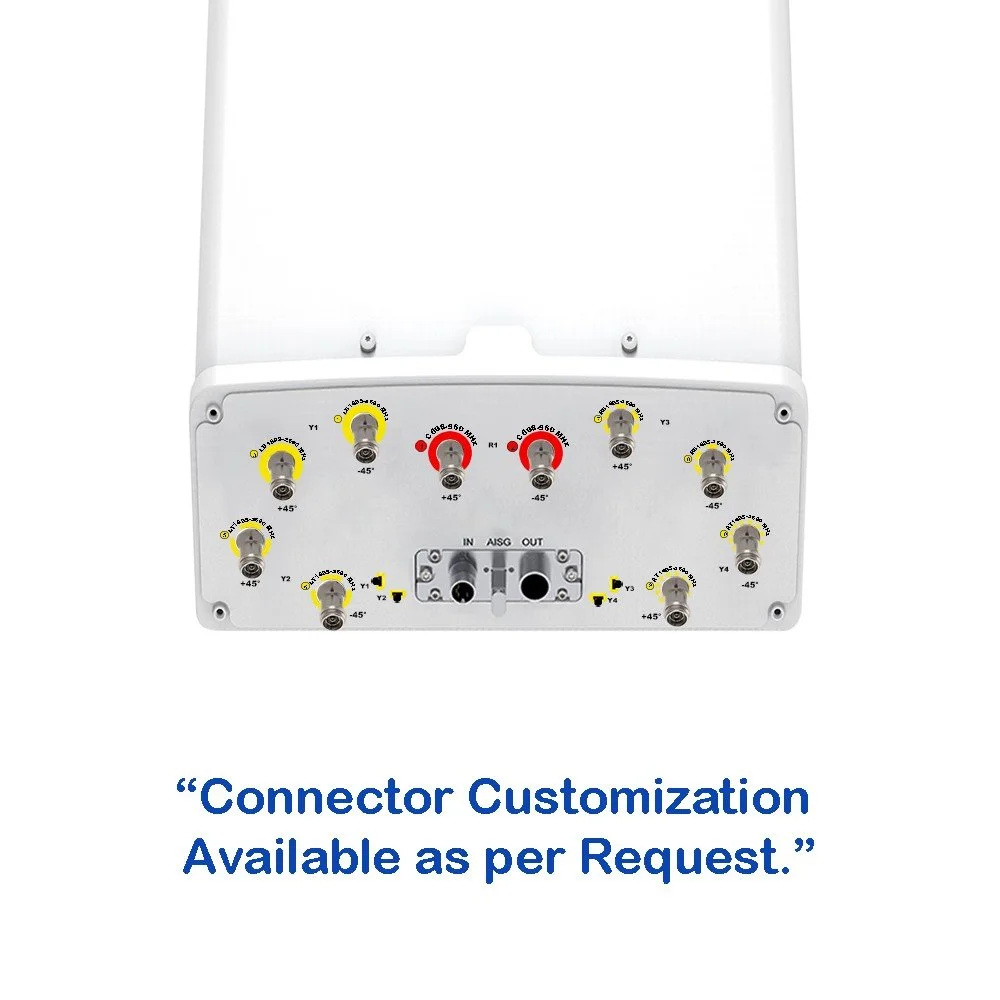
  • Connector type: N‑female, 4.3‑10, or customized per order

  • Operating temperature: −40°C to +65°C

  • Ingress protection: IP65/IP67

Applications :

  • Cellular macro sites for LTE and refarmed spectrum deployments

  • Multi‑operator and neutral host systems where multiple feed ports serve different carriers

  • High‑capacity urban sectors requiring advanced MIMO and carrier aggregation

  • DAS and small cell siting augmentation where wideband coverage from a single panel reduces clutter

Benefits :

  • Simplifies site hardware by consolidating broad frequency coverage into a single antenna

  • Reduces tower loading and visual impact compared with multiple discrete antennas

  • Enables flexible split of carriers/ports between operators without additional panels

  • Improves spectral efficiency through high isolation and optimized MIMO performance

  • Lowers OPEX through fewer parts, streamlined installs, and reduced maintenance

Ordering Options and Customization :

  • Port mapping: Custom assignment of ports to specific subbands or operators

  • Connector type and orientation: Select N‑female, 4.3‑10, or integrated jumpers

  • Azimuth beamwidth: 65° or 90° variants

  • Mechanical finish: Standard or enhanced corrosion protection for coastal sites

  • Integrated surge protection or external SPD compatibility

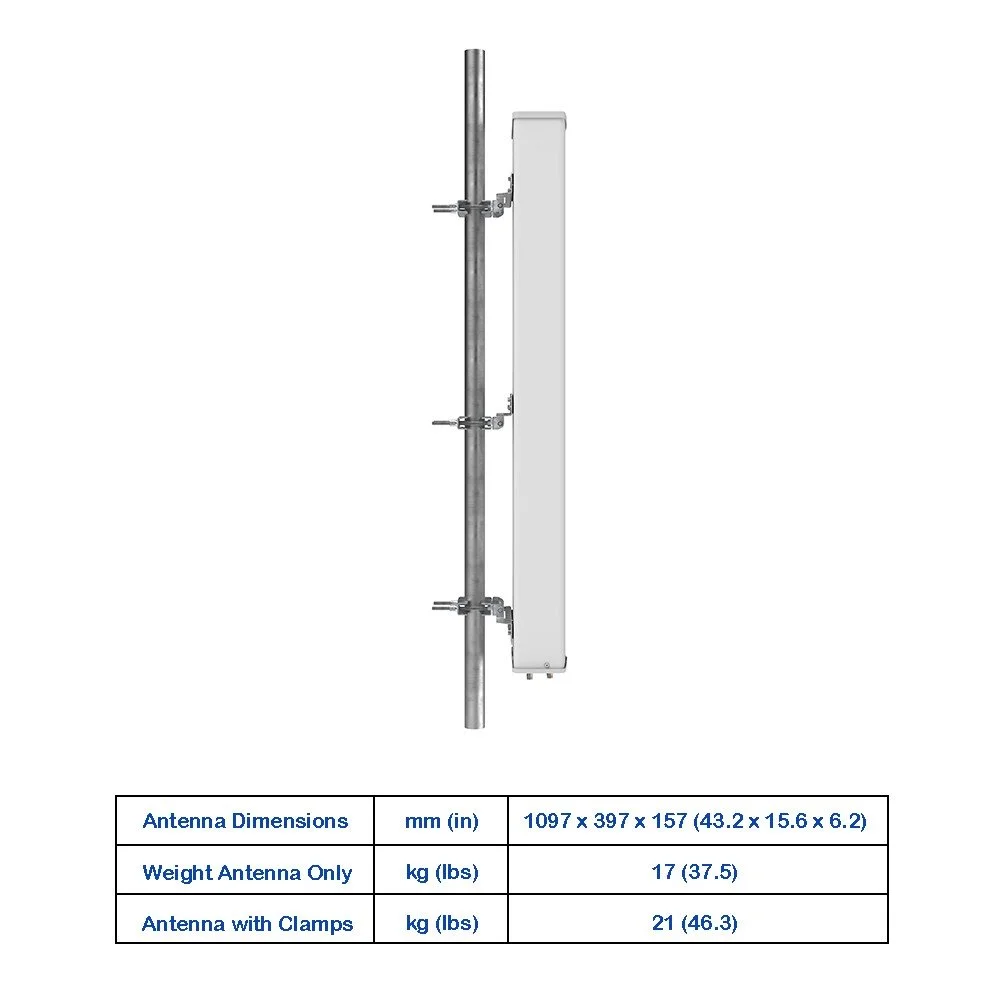
  • Mounting kit: Tower, wall, or pole options with tilt and alignment accessories

Compliance and Testing :

  • Factory‑measured radiation patterns and return loss across full band

  • Environmental testing to ETSI/ITU telecom standards for wind, salt spray, and thermal cycling

  • Electrical safety and lightning protection standards (per customer region)

Installation Notes :

  • Ensure clear line of sight for sector coverage; follow recommended mounting heights and downtilt for your site plan.

  • Use recommended low‑loss feeders and torque connectors per manufacturer specs to maintain VSWR performance

20‑Port Panel Sector Antenna (698–2690 MHz)

Overview

  • Frequency range: 698–2690 MHz — covers LTE bands, 3G, and legacy cellular allocations; suitable for multi‑operator macro sites and shared infrastructure.

  • Ports: 20 ports enabling multi‑input multi‑output (MIMO), diversity, and carrier aggregation across multiple bands.

  • Form factor: Slim, sector panel designed for rooftop, tower, and wall‑mount installations with low visual profile and robust environmental protection.

Key Features :

  • Wideband performance: Single‑antenna solution across 698–2690 MHz reduces the need for multiple discrete antennas and simplifies inventory and site integration.

  • Multi‑port architecture: 20 individually terminated ports support simultaneous multi‑sector configurations, multi‑operator deployments, or high‑order MIMO (e.g., 8x8 and beyond depending on configuration) and multiple carriers.

  • Optimized radiation patterns: Sectorized azimuth beamwidth (typically 65°–90° configurable per model) with controlled elevation tilt for efficient cell coverage and reduced inter‑cell interference.

  • Low VSWR and high port isolation: Ensures efficient power transfer, minimizes mutual coupling between ports, and preserves MIMO channel capacity.

  • High gain across bands: Carefully tuned element arrays deliver consistent gain to maximize link budget for both uplink and downlink.

  • Robust construction: IP65/IP67 environmental rating, corrosion‑resistant radome and mounting hardware for long service life in harsh outdoor conditions.

  • Lightning and surge protection: Integrated or easy‑to‑fit surge protection options to protect RF chains and meet telco site safety requirements.

  • Easy installation and alignment: Lightweight design, universal mounting bracket with azimuth/elevation adjustment, and clearly labeled feeders for fast site commissioning.

  • Weathering and UV resistance: Materials and finishes formulated for extended exposure to sun, salt spray, and temperature cycling.

Typical Specifications (example) :

  • Frequency range: 698–2690 MHz

  • Number of ports: 20

  • Port configuration: Combination of low‑band and mid‑band port groups (customizable mapping)

  • Polarization: Dual linear (vertical/horizontal) or slant ±45° per subarray

  • Nominal gain: 698–960 MHz: ~6–9 dBi; 1710–2690 MHz: ~8–12 dBi (model dependent)

  • VSWR: < 2.0:1 typical across each band

  • Port isolation: > 20 dB typical between co‑polarized adjacent ports; > 30 dB cross‑polarization isolation

  • Front-to-back ratio: > 20 dB typical

  • Beamwidth (azimuth): 65° / 90° variants available

  • Beamwidth (elevation): narrow beam shaping for sector coverage (model dependent)

  • Power handling: Meets standard BTS antenna input power requirements (check model for per‑port limits)

  • Impedance: 50 ohm

  • Connector type: N‑female, 4.3‑10, or customized per order

  • Operating temperature: −40°C to +65°C

  • Ingress protection: IP65/IP67

Applications :

  • Cellular macro sites for LTE and refarmed spectrum deployments

  • Multi‑operator and neutral host systems where multiple feed ports serve different carriers

  • High‑capacity urban sectors requiring advanced MIMO and carrier aggregation

  • DAS and small cell siting augmentation where wideband coverage from a single panel reduces clutter

Benefits :

  • Simplifies site hardware by consolidating broad frequency coverage into a single antenna

  • Reduces tower loading and visual impact compared with multiple discrete antennas

  • Enables flexible split of carriers/ports between operators without additional panels

  • Improves spectral efficiency through high isolation and optimized MIMO performance

  • Lowers OPEX through fewer parts, streamlined installs, and reduced maintenance

Ordering Options and Customization :

  • Port mapping: Custom assignment of ports to specific subbands or operators

  • Connector type and orientation: Select N‑female, 4.3‑10, or integrated jumpers

  • Azimuth beamwidth: 65° or 90° variants

  • Mechanical finish: Standard or enhanced corrosion protection for coastal sites

  • Integrated surge protection or external SPD compatibility

  • Mounting kit: Tower, wall, or pole options with tilt and alignment accessories

Compliance and Testing :

  • Factory‑measured radiation patterns and return loss across full band

  • Environmental testing to ETSI/ITU telecom standards for wind, salt spray, and thermal cycling

  • Electrical safety and lightning protection standards (per customer region)

Installation Notes :

  • Ensure clear line of sight for sector coverage; follow recommended mounting heights and downtilt for your site plan.

  • Use recommended low‑loss feeders and torque connectors per manufacturer specs to maintain VSWR performance

Electrical Specifications
Complete electrical specifications including gain, beamwidth, downtilt, suppression, isolation, impedance, VSWR, return loss and power ratings.
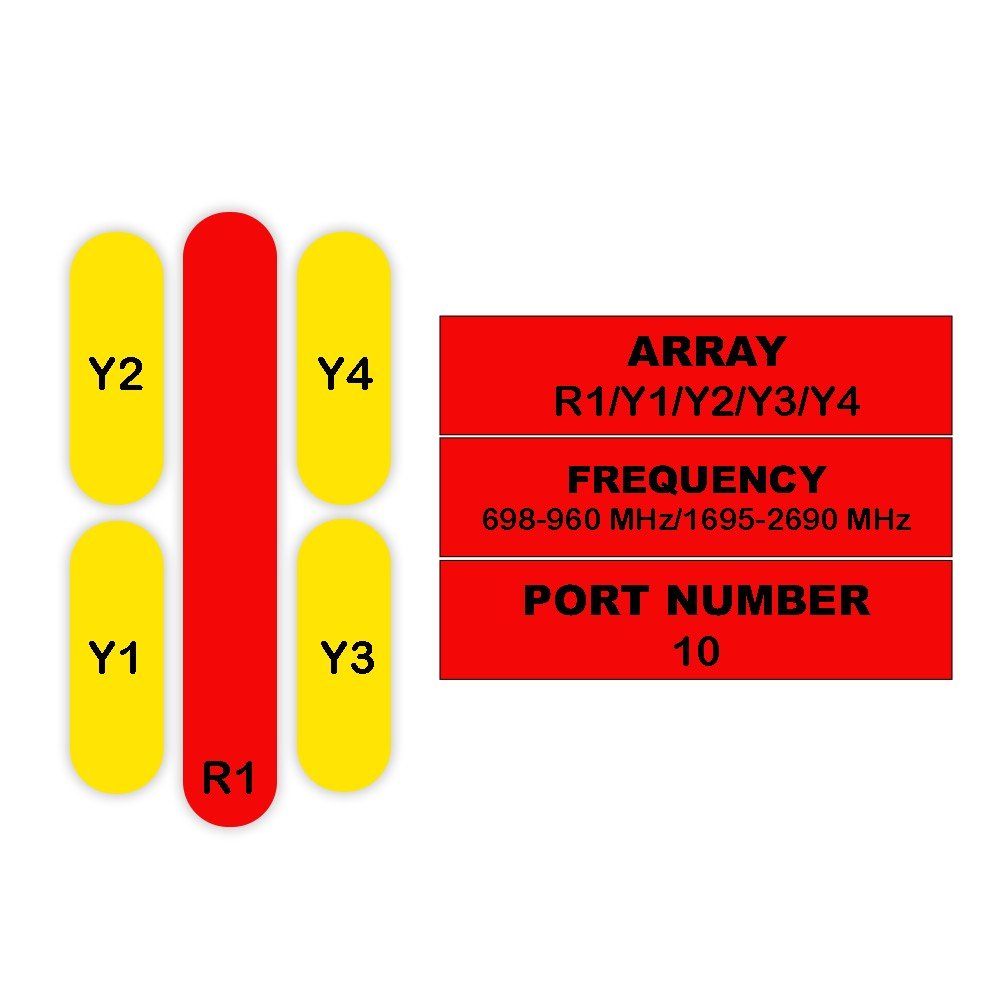
Parameter Sub Unit R1 / R2 Y1 / Y3 / Y5 / Y7 Y2 / Y4 / Y6 / Y8
698–960 MHz 1710–2690 MHz 1710–2690 MHz
698–806 790–894 880–960 1710–1880 1850–1990 1920–2170 2300–2400 2490–2690 1710–1880 1850–1990 1920–2170 2300–2400 2490–2690
Polarization ±45° ±45° ±45°
Gain At Mid Tilt dBi 13.814.114.4 13.814.114.414.714.7 13.613.914.214.514.5
Over All Tilts dBi 13.6 ± 0.513.9 ± 0.514.2 ± 0.5 13.6 ± 0.613.9 ± 0.514.2 ± 0.614.5 ± 0.614.5 ± 0.6 13.4 ± 0.613.7 ± 0.514.0 ± 0.614.3 ± 0.614.3 ± 0.6
Horizontal Beamwidth degree 66 ± 4.463 ± 3.661 ± 4.6 70 ± 6.168 ± 6.166 ± 6.564 ± 6.063 ± 6.5 70 ± 6.168 ± 6.166 ± 6.564 ± 6.063 ± 6.5
Vertical Beamwidth degree 14.9 ± 1.113.2 ± 0.912.2 ± 0.9 15.3 ± 0.614 ± 0.512.6 ± 0.511.5 ± 0.410.5 ± 0.6 12.7 ± 0.611.7 ± 0.510.5 ± 0.59.6 ± 0.48.7 ± 0.6
Electrical Downtilt Continuous degree 2–12 2–12 2–12
Tilt Accuracy degree < 1
Upper Side Lobe Suppression First Upper Lobe dB > 15
Peak to 20° dB > 15
Front-To-Back Ratio ±30° dB >20>21>22 >22>22>23>24>24 >22>22>23>24>24
Cross Polar Discrimination At Boresight dB >15>16>16 >16>16>16>17>17 >16>16>16>17>17
Over Sector dB >8.0>7.5>6.5 >6.0>7.0>7.0>4.0>3.0 >6.0>7.0>7.0>4.0>3.0
Isolation Cross-Polar dB >25
Port-To-Port dB >25 (R1//R2), >28 (R1//Y1–Y8) >28 >28
Impedance Ohm 50
VSWR < 1.5
Return Loss dB > 14
PIM3 (2x43 dBm Carrier) dBc < -150
Lightning Protection DC Ground
Maximum Avg Input Power / Port (50°C) Watts 250 200 200
Integrated RET Specifications including electrical, mechanical, environmental, and interface details.
Parameter Specification
Integrated RET Specifications
Protocols Compliant to AISG v2.0 and 3GPP
Supply Voltage Range 10–30 V DC; Compliant to AISG 2.0 and 3GPP TS25.461 V6.0.0
Power Consumption – Standby < 2 W
Power Consumption – In Motion < 10 W
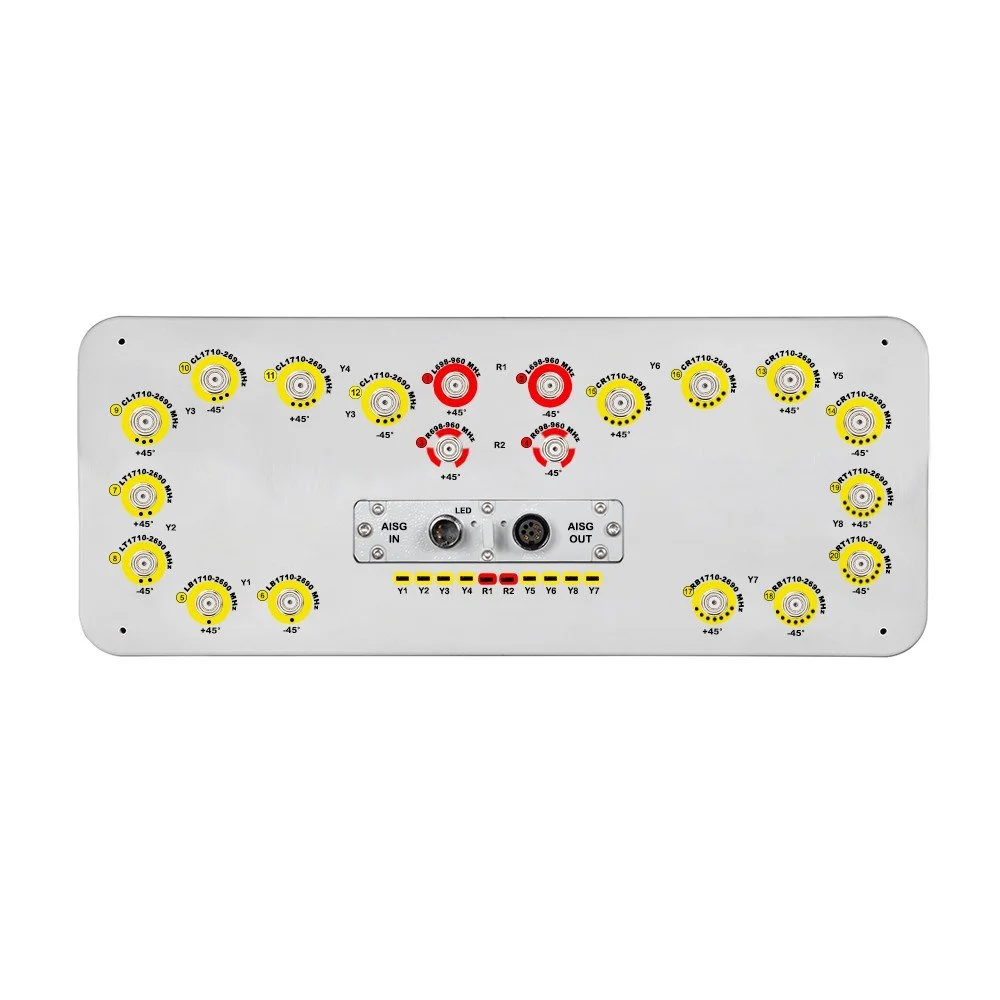
Connectors 2 × 8 Pin Circle Connector according to IEC 60130-9 and AISG
Daisy Chain In: Male
Daisy Chain Out: Female
Pin3: RS485B; Pin5: RS485A; Pin6: 10–30 V; Pin7: DC Return
Female Connector: 8 PINs; Male Connector: 4 PINs
Hardware Interfaces RS485 and Power
Adjustment Time ≤ 90 sec (typical, depending on antenna type)
Adjustment Cycles > 20,000
Torque Maximum ≥ 160 mN•m (@ 30 RPM)
Lightning Protection Rating IEC 61000-4-5 Current Pulse Profile
Line to Ground: 8/20 µs @ 8 kA ≥ ±5 Repetitions
Line to Line: 8/20 µs @ 3 kA ≥ ±5 Repetitions
Remote Control Can be managed from OMC, BTS/Node B
Daisy Chaining Method Ready for daisy-chaining
Safety Standard Compliant to EN 60950 / UL 60950 / RoHS, CE
Housing Material / Color Aluminum / Grey
Operating Temperature -40° to +70° C (-40° to +158° F)
Storage Temperature -55° to +75° C (-67° to +167° F)
Humidity Up to 95%
IP Rating IP65
Weight ≤ 500 g
Mechanical Specifications including connectors, dimensions, wind load, and environmental ratings.
Parameter Specification
Mechanical Specifications
Connector Type (20x) 4.3/10 Female
Connector Position Bottom
Electrical Tilt Control Integrated RET
Radome Material Fiberglass
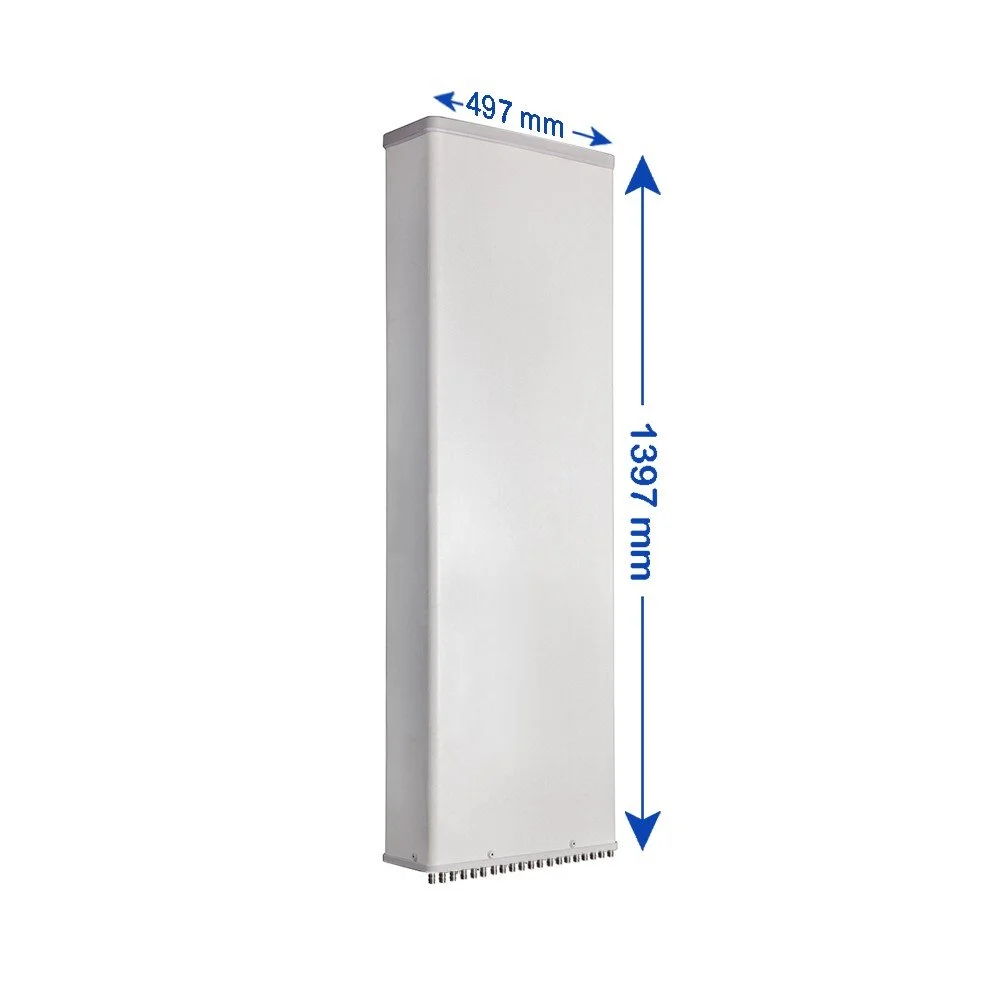
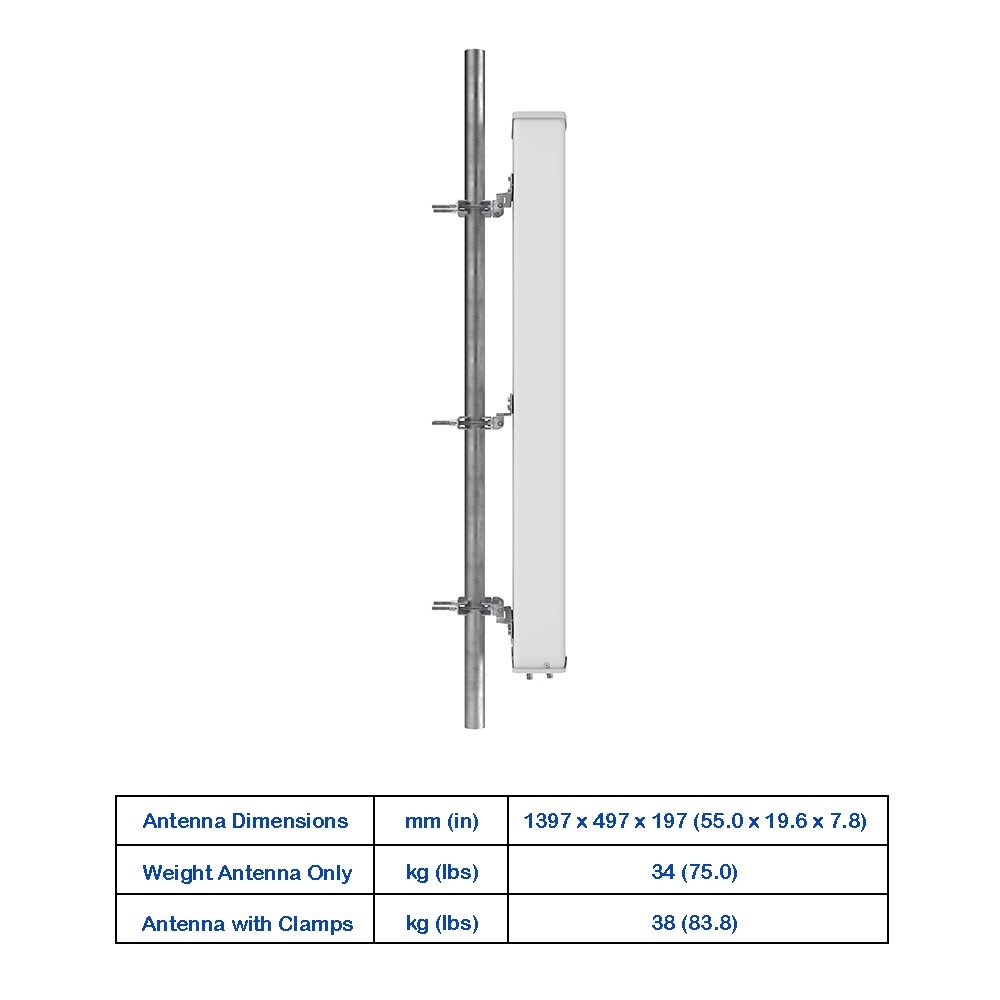
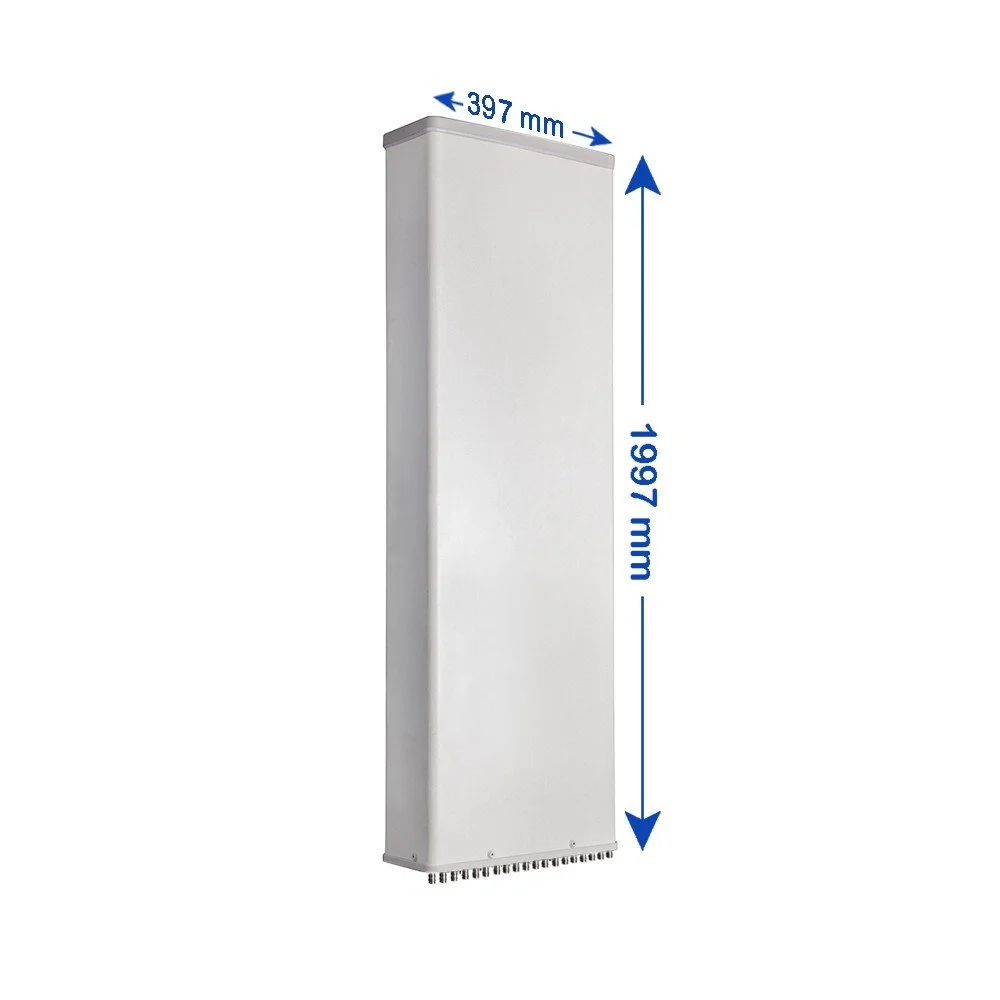
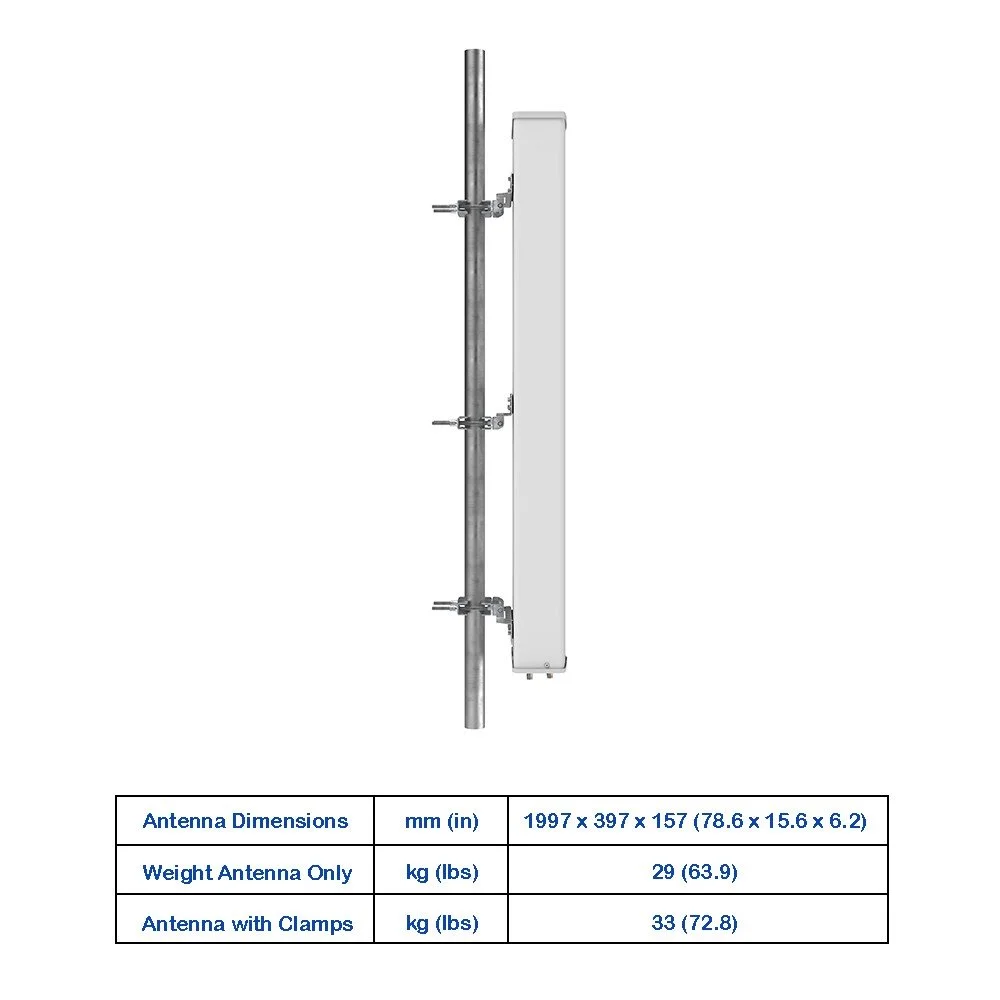
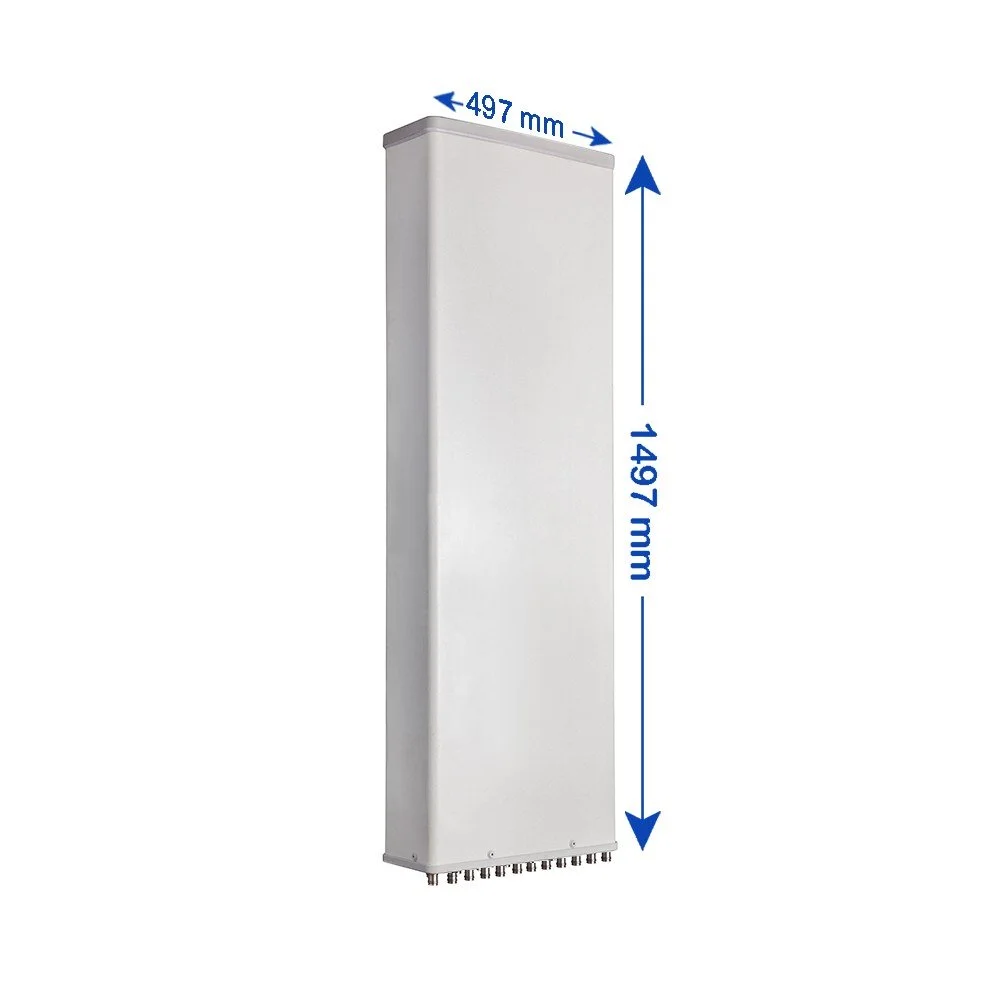
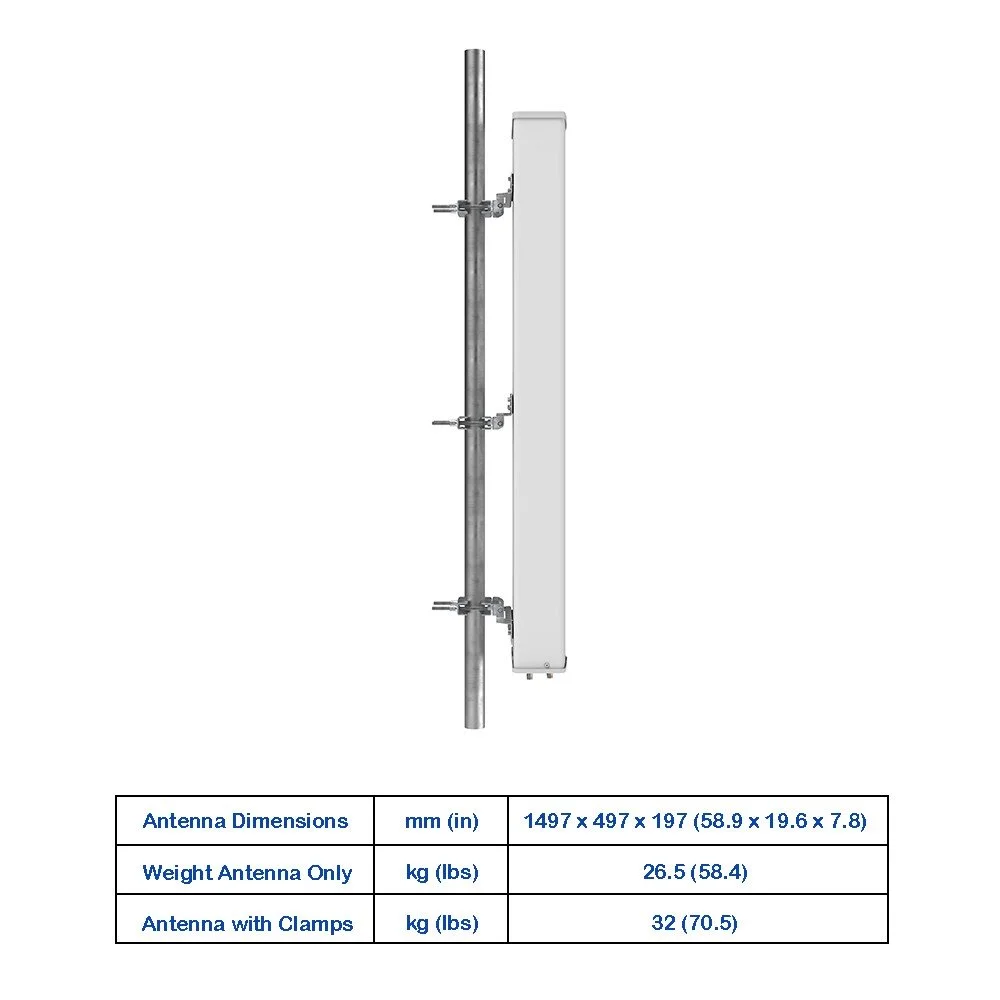
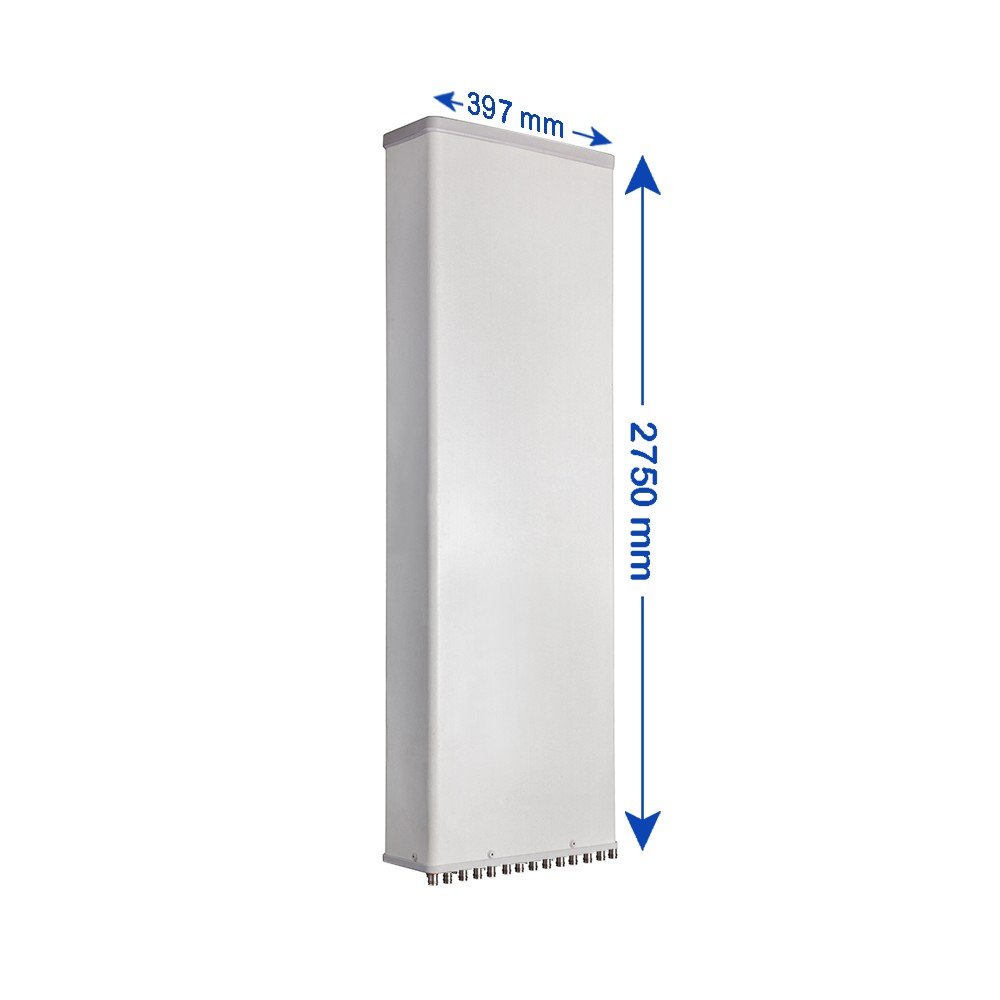
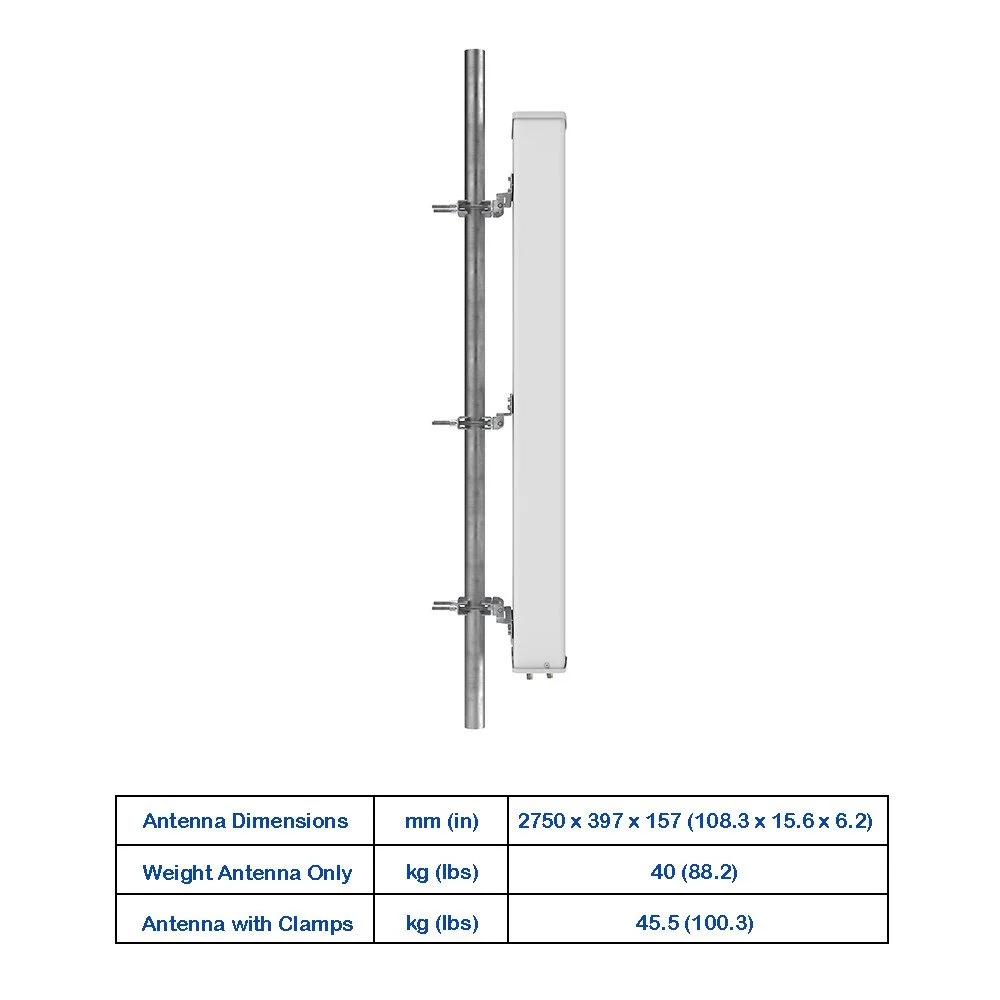
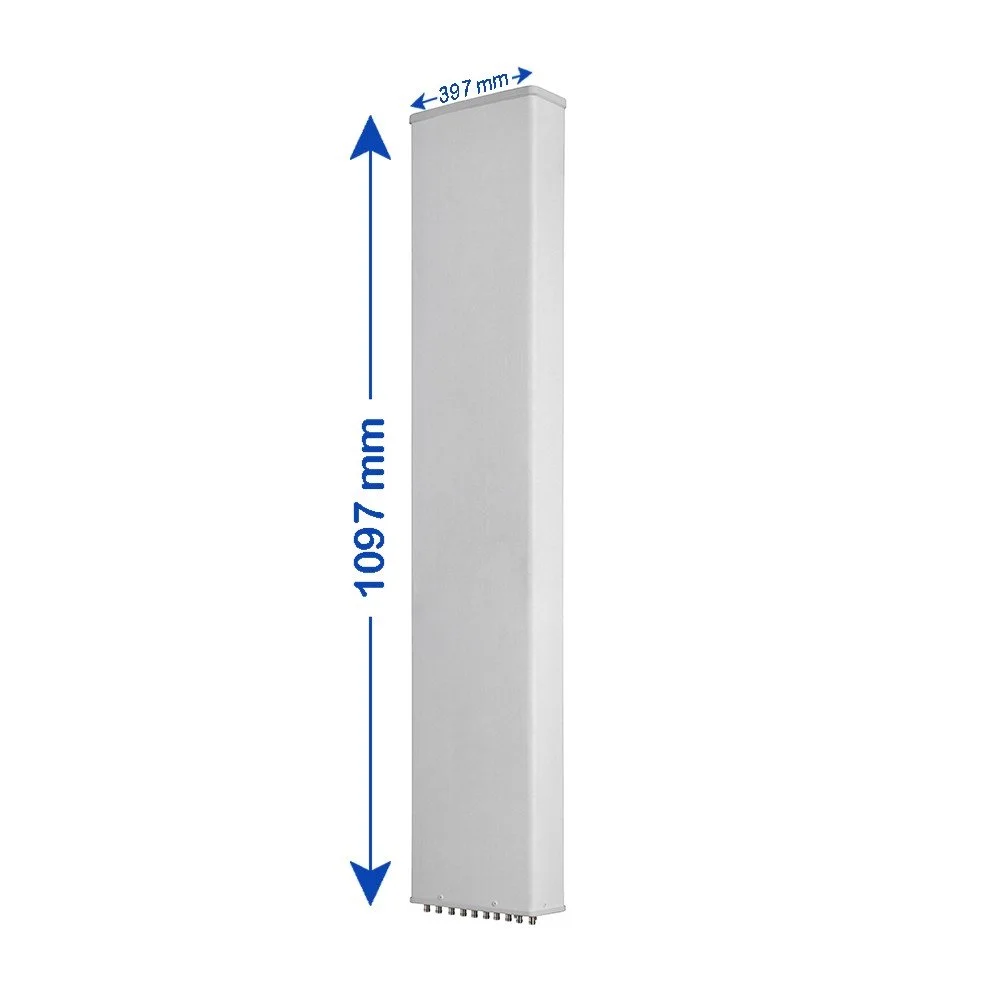
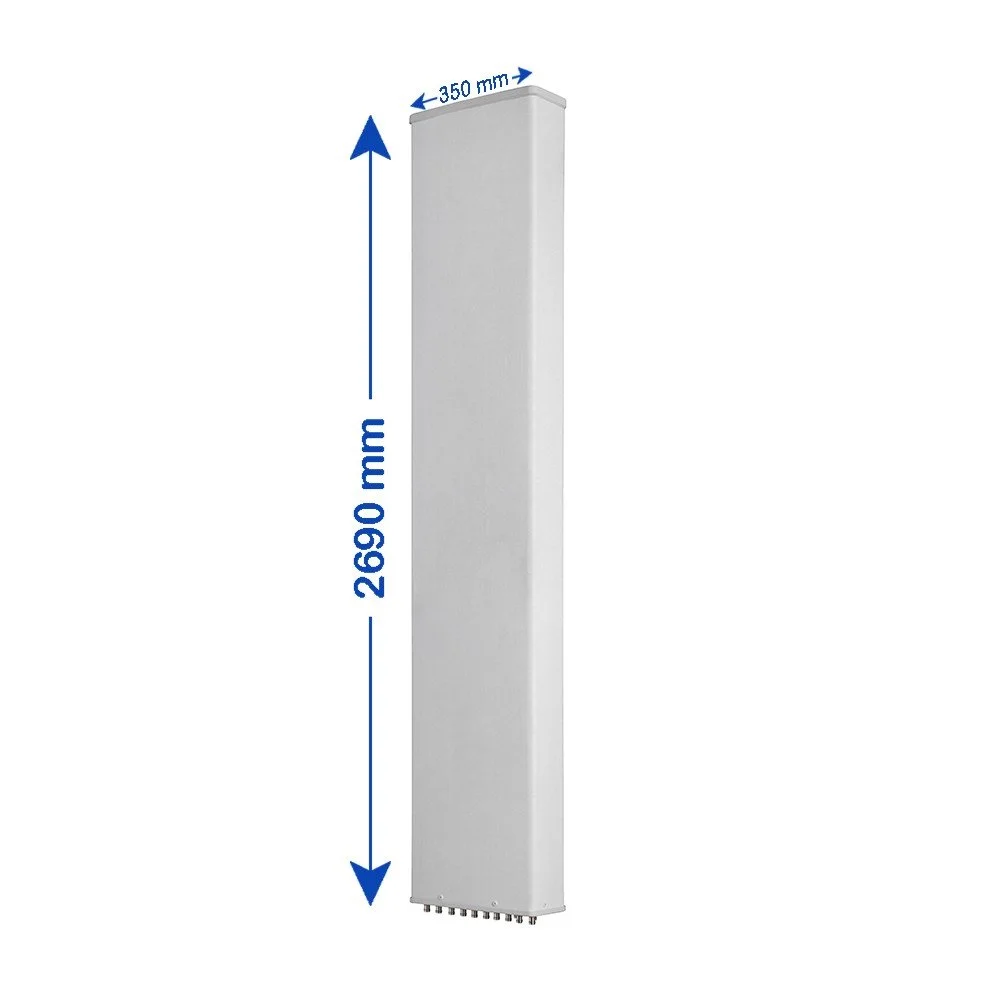
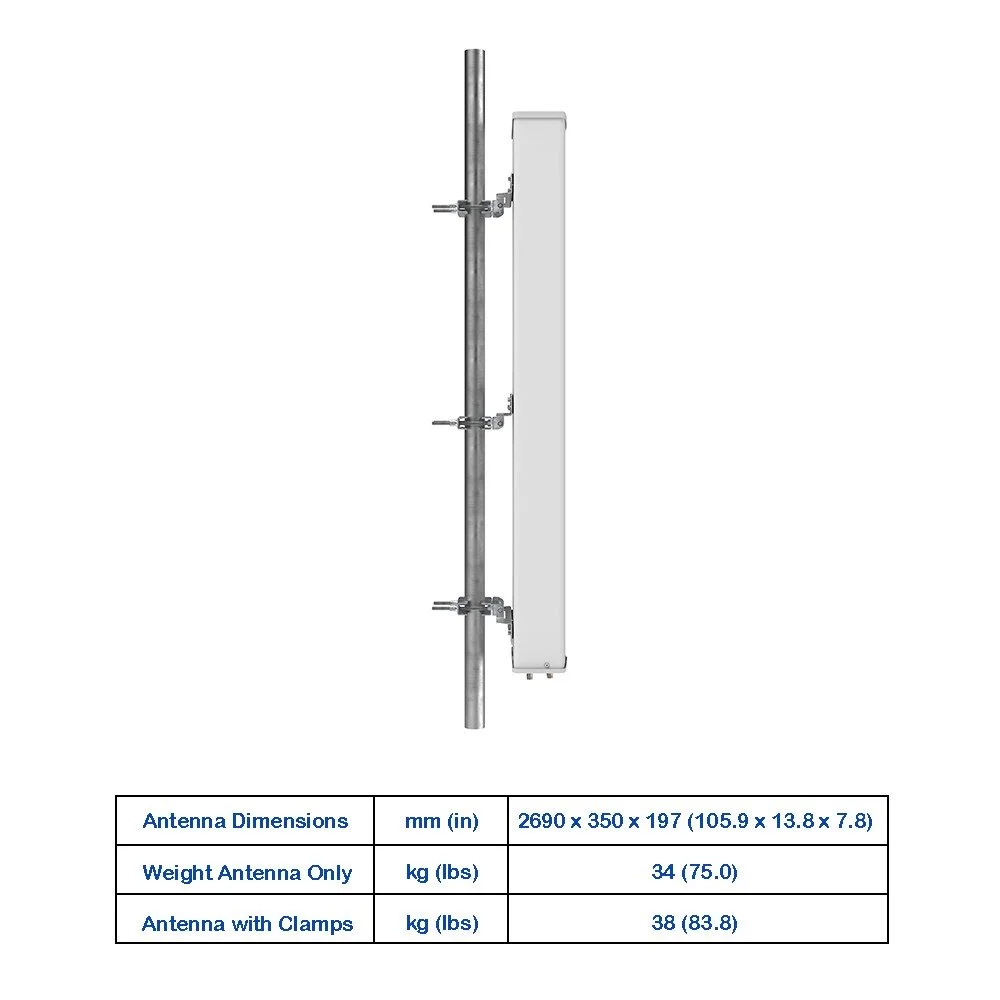
Antenna Dimensions (H × W × D) 1397 × 497 × 197 mm (55.0 × 19.6 × 7.8 in)
Antenna Weight – Antenna Only 34 kg (75.0 lbs)
Antenna Weight – With Clamps 38 kg (83.8 lbs)
Maximum Wind Speed 200 km/h (124.3 mph)
Wind Load at 150 km/h – Frontal 640 N (143.9 lbf)
Wind Load at 150 km/h – Rear 715 N (160.7 lbf)
Wind Load at 150 km/h – Lateral 315 N (70.8 lbf)
Operating Temperature -40 to +60 °C (-40 to +140 °F)